Your Core Doesn't Need an Hour: It Needs 10 Minutes, 10 Movements, 1 Minute Each
17 hours ago
11 minute read.

Short Answer (Blog Briefing)
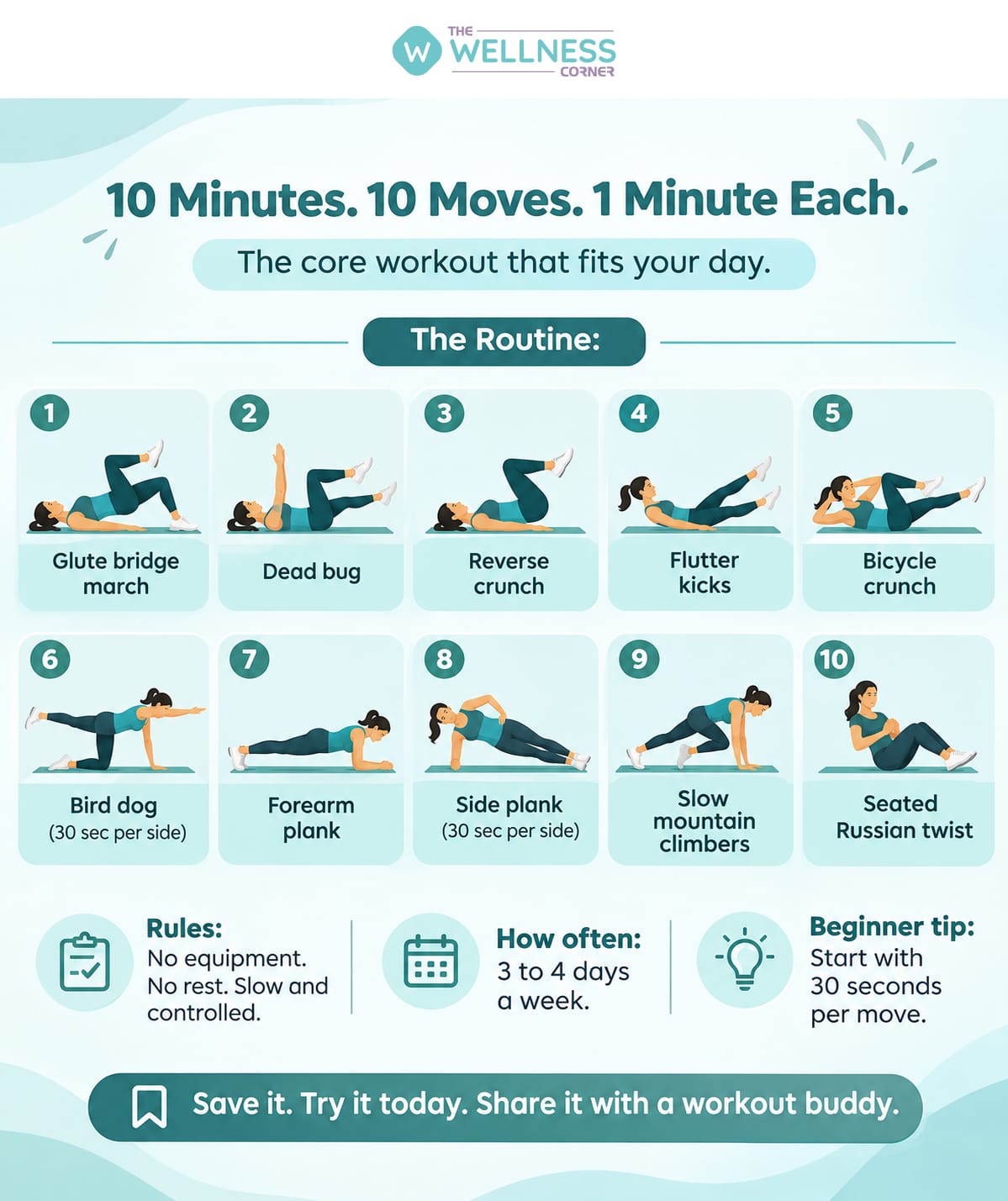
Most people skip core training because they think it takes an hour, a gym and a lot of crunches. It does not. A well-planned 10 minute core workout, with ten different movements and one minute on each, trains your abs, obliques, deep stabilisers and lower back in less time than a tea break.
Below you will find the full routine, easy and hard versions of every move, and answers to the questions people search most: is 10 minutes enough, how often to train, and what to do if you are a beginner, an office worker or dealing with a sore lower back.
Also Read: Strengthen Your Core to Manage Your Emotions And Gut-Brain Connection Effectively
Is a 10 Minute Core Workout Enough?
For most people, yes, as long as it is part of a wider routine. Consistency matters more than length. Ten focused minutes three or four times a week will do more for you than one long session you never repeat.
Here is what the guidelines say. The World Health Organization recommends that adults do muscle-strengthening activities involving all major muscle groups on 2 or more days a week, alongside 150 to 300 minutes of moderate aerobic activity. Your core is one of those muscle groups, and a short, targeted session is a practical way to cover it.
Two honest limits to know:
- Core work will not burn belly fat on its own. Training a specific area strengthens its muscles but does not guarantee fat loss in the same region.
- Visible abs depend on overall body fat, which comes from your total activity and eating habits.
- A core routine is not a full workout. Pair it with walking or other cardio and strength work for your legs, back, chest and arms.
How Long Should a Core Workout Be?
A session lasting 10 to 20 minutes is often enough to make a meaningful difference. Your core muscles work mainly to stabilise your spine, so quality, control and consistency count more than duration. If your form breaks down after minute eight, the extra time is not helping. That is why a short ab workout built around good technique beats a long, sloppy one.
Also Read: Why Is Core Strength Important?
How the 10-10-1 Core Workout Works
- 10 movements: a mix of stability, rotation and anti-extension moves so every part of the core gets work.
- 1 minute each: that is the whole routine, 10 minutes in total. Side-specific moves (bird dog and side plank) use 30 seconds per side.
- No scheduled rest: moves flow one into the next. The few seconds you spend changing position is your recovery. If you truly need a pause, take 10 seconds and carry on.
- No equipment: these are all bodyweight core exercises, so you only need a mat or a soft floor.
- Pace: slow and controlled. Every move should feel like it is working your core, not your neck or lower back.
If you like, spend one minute before you start on a warm-up: gentle hip circles, marching on the spot and a few cat-cow stretches.
The 10 Minute Core Workout: 10 Exercises, 1 Minute Each
The order below keeps you on the floor with as few position changes as possible: lying on your back first, then kneeling, then planks, then finishing seated.
1. Glute Bridge March (1 minute)
Lie face-up with your knees bent and the soles of your feet placed firmly on the floor. Raise your hips to form a bridge, bring one knee towards your chest, return it to the starting position, and repeat with the other leg. Keep your hips level.
- Easier: hold a static bridge.
- Harder: slow the march down and pause for 2 seconds at the top of each lift.
2. Dead Bug (1 minute)
With your back resting on the floor, raise both arms and bend your knees to form right angles. Gradually lower one arm and the opposite leg, then return to the starting position before changing sides. Keep your lower back in contact with the floor and exhale as you extend.
- Easier: move only your legs.
- Harder: extend the arm and leg further from the body.
The dead bug is one of the best core stability exercises because it teaches your deep abdominal muscles to hold your spine steady while your limbs move.
3. Reverse Crunch (1 minute)
Lie on your back with your knees bent and lifted over your hips. Bring your thighs closer to your chest, allowing your pelvis to rise slightly, then slowly lower your hips back down. Do not swing your legs.
- Easier: use a smaller range of motion.
- Harder: straighten your legs slightly at the bottom.
4. Flutter Kicks (1 minute)
Position yourself on your back with your legs straight and hovering just above the ground. Make small, quick alternating kicks. Maintain contact between your lower back and the floor throughout the movement.
- If you find this challenging, try bending your knees or placing your palms beneath your hips for support.
- Lower back pain: skip this move and repeat the dead bug instead.
5. Bicycle Crunch (1 minute)
With hands lightly behind your head, bring one elbow toward the opposite knee while extending the other leg. Rotate through your ribcage rather than pulling on your neck.
- Easier: tap your toes alternately on the floor.
- Harder: slow it right down.
6. Bird Dog (1 minute: 30 seconds per side)
Begin on all fours and stretch your right arm forward while extending your left leg backwards, keeping both aligned with your torso. Hold steady, then switch sides at 30 seconds. Make sure your hips remain parallel to the floor without twisting your lower body.
- Easier: lift only the leg.
- Harder: pause for 3 seconds at full extension.
7. Forearm Plank (1 minute)
Place your elbows under your shoulders and form a straight line from head to heels. Squeeze your glutes, tuck your ribs down and breathe steadily.
- Easier: drop to your knees, or do three 20-second holds.
- Harder: lift one foot an inch off the floor for 10 seconds at a time.
8. Side Plank (1 minute: 30 seconds per side)
Lie on your side, elbow under your shoulder, and lift your hips so your body forms a straight line. Hold for 30 seconds, then switch sides.
- For a simpler variation, keep your knees bent and rest your feet on the floor.
- Harder: lift your top arm or leg.
9. Slow Mountain Climbers (1 minute)
From a high plank, bring one knee toward your chest, return it, and switch. Move at a steady, controlled pace and keep your hips low.
- Easier: place your hands on a sturdy bench or sofa.
- Lower back pain: replace with a plank hold.
10. Seated Russian Twist (1 minute)
Sit with knees bent and lean back slightly with a long spine. Rotate your torso from side to side, bringing your hands toward the floor each time.
- Easier: keep your feet on the floor.
- Harder: lift your feet and hold your hands together.
- Lower back pain: replace with slow standing knee-to-elbow crunches.
Quick Reference: 10 Minute Core Workout Plan
|
# |
Exercise |
Time |
Main focus |
|
1 |
Glute bridge march |
1 min |
Glutes, deep core |
|
2 |
Dead bug |
1 min |
Core stability |
|
3 |
Reverse crunch |
1 min |
Lower abs |
|
4 |
Flutter kicks |
1 min |
Lower abs, hip flexors |
|
5 |
Bicycle crunch |
1 min |
Abs, obliques |
|
6 |
Bird dog |
30 sec per side |
Back, balance, stability |
|
7 |
Forearm plank |
1 min |
Whole core |
|
8 |
Side plank |
30 sec per side |
Obliques, side stability |
|
9 |
Slow mountain climbers |
1 min |
Core, shoulders, endurance |
|
10 |
Seated Russian twist |
1 min |
Obliques, rotation |
Best 10 Minute Core Workout for Beginners at Home
New to exercise? You do not need to do all ten moves for a full minute on day one. Use this simple progression, a gentle abs workout for beginners that builds up over four weeks:
- Week 1: 30 seconds per move, using the easier version of each. 3 days.
- Week 2: 40 seconds per move. 3 days.
- Week 3: 50 seconds per move. 3 to 4 days.
- Week 4: the full 1 minute per move.
The goal for the first month is controlled movement, steady breathing and zero pain. Speed and difficulty can wait.
How Often Should You Train Your Core?
Most people do well with 3 to 4 sessions a week on non-consecutive days, which also meets the WHO's recommendation of muscle-strengthening on 2 or more days a week. Your core can handle more frequent, gentler work than big muscles like your legs, but if your abs or back feel sore or fatigued, give them a day off. Rest days are when your muscles adapt and get stronger.
Core Workout for Women and Core Workout for Men
The core muscles are the same in women and men, so this routine works for both. What differs is life stage and goals, not anatomy.
- For women: if you are pregnant or have recently given birth, or have been told you have diastasis recti (separation of the abdominal muscles), check with your doctor or a women's health physiotherapist before starting. Some moves, such as crunches and planks, may need to change.
- For men: many men lean on crunches and sit-ups and neglect stabilising moves. The dead bug, bird dog and side plank in this routine fill that gap and protect the lower back during lifting and sport.
10 Minute Core Workout for Office Workers
Long hours at a desk can leave your trunk muscles underused. You can do a 10 minute core workout for office workers with no floor space needed:
- Standing knee-to-elbow crunches: 1 minute, alternating sides.
- Incline plank on the desk: place your hands on a sturdy desk edge and hold for 1 minute.
- Seated knee lifts: sit tall, hold the chair edge and lift your knees alternately for 1 minute.
- Seated or standing twists: rotate gently from side to side for 1 minute.
- Standing bird dog: hold a wall for balance, extend opposite arm and leg, 30 seconds per side.
Also stand up and move every 30 to 60 minutes. A strong core helps, but frequent movement is what really counters sitting.
10 Minute Core Workout for Lower Back Pain
A stronger core can help support your spine, and health services such as the NHS advise staying active when you have back pain rather than resting for long periods. Still, some core moves can aggravate a sore back.
- Choose gentler moves: glute bridge, dead bug, bird dog and side plank (with knees bent) are usually well tolerated.
- Skip or swap: flutter kicks, mountain climbers and Russian twists.
- Keep your lower back neutral, neither arched nor rounded, and stop if the pain gets worse.
- See a doctor or physiotherapist if the pain does not improve after a few weeks, is severe, or comes with numbness, weakness, fever or loss of bladder or bowel control. In those cases, get urgent medical help.
10 Minute Core Workout Before Bed
Yes, you can, with one tweak: slow down. A gentle, slow-tempo session of dead bugs, bridges, bird dogs and planks is a calm way to end the day. Skip fast moves like mountain climbers and flutter kicks if hard exercise close to bedtime keeps you awake. Everyone reacts differently, so notice how you sleep and adjust.
10 Minute Core Workout After Cardio
Doing core work after cardio is fine, because your muscles are already warm. If you are tired and your form slips, choose the easier versions or shorten each move to 30 seconds. If you are doing strength training too, do your core last so it is not fatigued before heavy lifts that need a stable spine.
10 Minute Core Workout for Strong Abs and Better Posture
A stronger core helps you hold your spine in a stable position through the day, but posture also depends on habits. To get more from each 10 minute core workout:
- Move or stretch every 30 to 60 minutes if you sit for work.
- Set up your screen at eye level and keep your back supported.
- Include back and glute strengthening, not only abs. The bridge and bird dog in this routine do exactly that.
- Be patient. Visible changes in abs take weeks of consistency, plus attention to overall activity and nutrition.
Also Read: Maintaining Good Posture When Working From Home
Common Core Workout Mistakes
- Pulling on your neck during crunches. Keep your gaze up and lead with your ribcage.
- Letting your lower back arch in leg lowering moves. Press it into the floor or shorten the range.
- Holding your breath. Breathe out on effort and keep breathing steadily.
- Rushing. Slow reps work your core harder than fast, bouncing ones.
- Only doing crunches. Core strength includes stability, rotation and back muscles.
- Ignoring pain. Muscle burn is normal. If discomfort becomes sharp or does not subside, stop exercising.
Final Thoughts
You do not need an hour, a gym or a stack of equipment to train your core. A 10 minute core workout with ten movements, one minute each, is a realistic habit you can stack onto your morning, your lunch break or your evening wind-down. Start at your level, move with control, and aim for consistency over intensity. In a few weeks, you should notice a steadier, stronger centre.
Ready to build on your 10 minutes? Get more from every workout with guided wellness programmes and expert support on The Wellness Corner app.
Sources and Further Reading
- World Health Organization: Physical activity fact sheet
- NHS: Back pain, what to do and when to see a GP
- US Department of Health and Human Services: Physical Activity Guidelines for Americans, 2nd edition (executive summary)
Disclaimer: This article is for general information and is not medical advice. Please consult a doctor before starting a new exercise routine, especially if you are pregnant, recovering from injury or surgery, or living with a medical condition.
Frequently Asked Questions About the 10 Minute Core Workout
Leave a Comment

Sign-Up Now & Unlock
₹100 Cashback
Subscribe to our Newsletter!
Get a weekly dose of wellness tips delivered straight to your inbox.
Recently Published
Related Articles


Health Checks @ Home
Service
Explore



Follow us on:


© 2026 Truworth Health Technologies Pvt. Ltd.