10 Desk Exercises To Fix Stiff Necks, Sore Backs, And Tight Hips
16 hours ago
7 minute read.
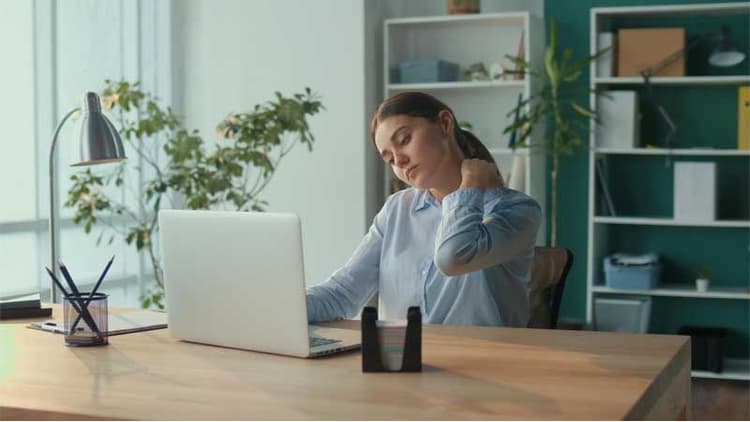
A sedentary workday can take a toll on your body, often leaving the neck, shoulders, back, and hips feeling tight or sore. Regular movement can help reduce the effects of prolonged sitting and support better mobility. Simple desk exercises, stretches, and movement breaks can be done without leaving your workstation and can easily fit between meetings, calls, or tasks.
1. How Prolonged Sitting Can Affect Your Body?
2. 10 Simple Exercises to Try During Your Workday
3. How Often Should You Move During the Workday?
4. How to Make Your Desk Setup More Body-Friendly?
5. When Desk Exercises Are Not Enough?
6. Frequently Asked Questions
How Prolonged Sitting Can Affect Your Body?
You sit down to answer one email. Then comes a meeting, followed by another task, another call, and suddenly three hours have passed.
Your shoulders feel heavy. Your neck feels tight. Your lower back is complaining. And your hips seem to have forgotten what standing upright feels like.
Sound familiar?
Desk-based work can make it easy to spend most of the day in the same position. Over time, this lack of movement may make your muscles feel stiff, with the neck, shoulders, back, and hips often feeling the effects.
The solution does not necessarily mean spending an hour at the gym after work. Even a few minutes of movement between tasks can make a difference.
Need a quick movement break at work? Here are 10 office exercises you can try.
Also Read: Doing These Things At The Desk Is Making You Feel Tired
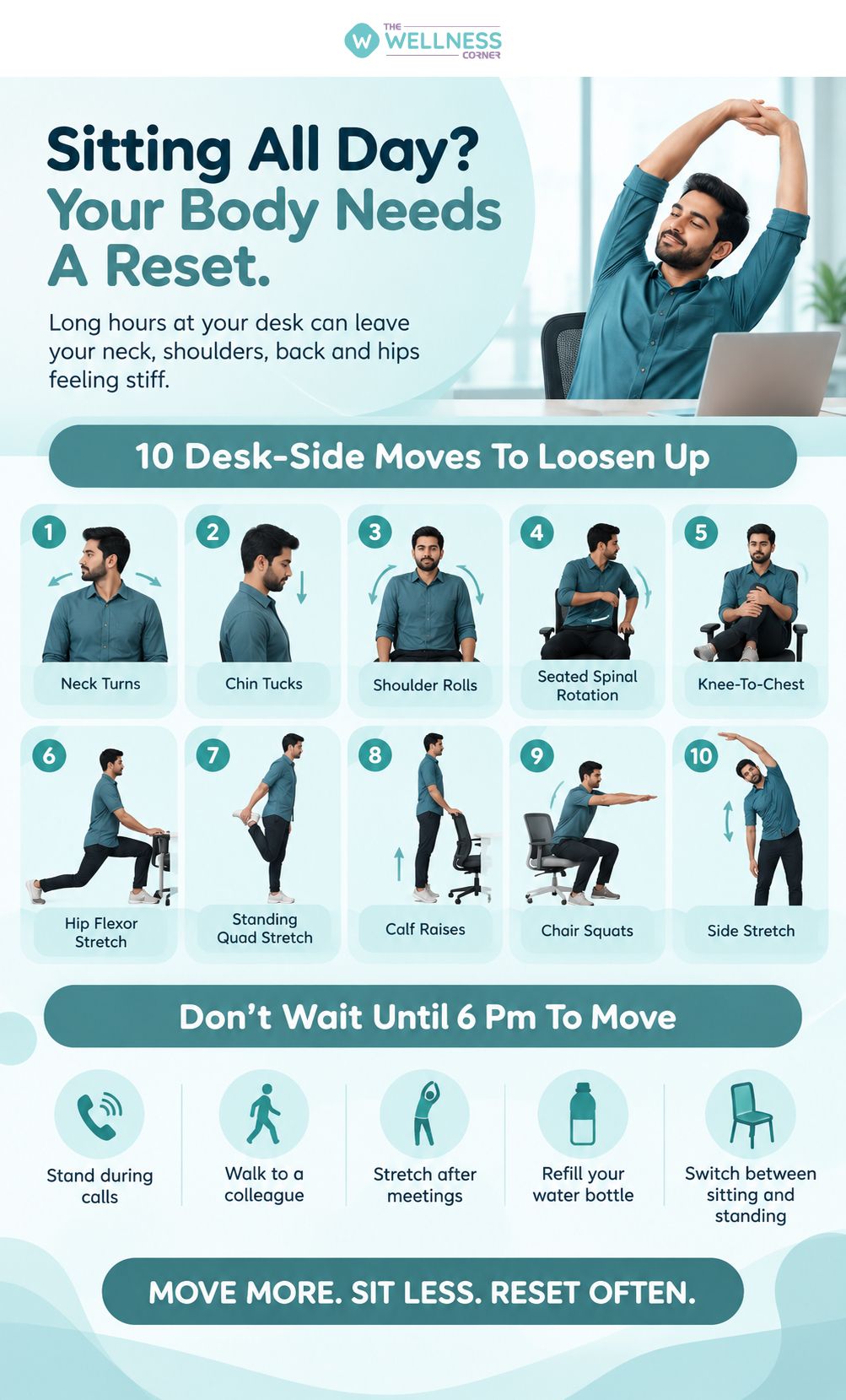
1. Neck Turns For A Stiff, Tired Neck
Hours of screen-based work may leave your neck feeling tight, tired, or restricted.
Sit upright with your shoulders relaxed. Slowly turn your head to the right until you feel a comfortable stretch. Reset to your neutral position, then gently move to the left side.
Avoid forcing your head beyond a comfortable range.
Aim for 5 to 10 repetitions per side.
These gentle movements are among the easiest stiff neck exercises to incorporate between tasks.
2. Chin Tucks To Reset Your Neck
If you spend much of your day leaning towards your screen, chin tucks can provide a useful movement break.
Sit tall and look straight ahead. Gently draw your chin backwards, as though you are trying to create a small double chin. Stay in the position briefly, then release and relax.
Repeat 8 to 10 times.
The movement should be subtle. Do not tilt your head downward while performing it.
These can be particularly useful as desk exercises for neck and shoulder pain related to prolonged screen use.
Also Read: How To Fix Your Stiff Neck In 60 Seconds?
3. Shoulder Rolls To Release Built-Up Tension
Notice how often your shoulders creep towards your ears when you are concentrating?
Shoulder rolls are a simple way to introduce movement.
Sit or stand comfortably. Slowly roll both shoulders upwards, backwards, and downwards. Then reverse the direction.
Repeat 8 to 10 times in each direction.
These best office exercises take less than a minute and can be performed during a quick break without interrupting your workflow.
4. Seated Spinal Rotation For A Stiff Back
This seated twist can help loosen the upper and mid-back after spending too long in the same position.
Sit upright near the front of the chair with your feet resting flat beneath you. Place your hands across your chest. Slowly rotate your upper body to one side while keeping your hips facing forward.
Return to your neutral position before switching sides.
Perform 5 to 8 repetitions per side.
Move slowly rather than trying to rotate as far as possible.
Also Read: Is It Safe To Use Vibrating Massage Guns To Relieve Stiffness?

5. Seated Knee-To-Chest Stretch
Give your lower back a chance to loosen up after spending too much time seated.
Sit securely in your chair and bring one knee towards your chest, holding it gently with your hands. Keep your back comfortable and avoid pulling aggressively.
Hold for around 15 to 20 seconds, then switch sides.
This can be included among the lower back pain exercises you perform during a workday, provided the movement feels comfortable for you.
6. Hip Flexor Stretch For Tight Hips
During sitting, your hip flexors remain in a bent position rather than fully lengthening. If you spend most of your day at a desk, giving them opportunities to move can be helpful.
Move behind your chair and hold onto it to stay steady. Step one foot backwards and gently bend your front knee while keeping your torso upright. You should feel a comfortable stretch around the front of the hip of the leg positioned behind you.
Hold for 15 to 30 seconds and switch sides.
These simple hip flexor exercises can be especially useful if you experience tight hips from sitting.
Also Read: 7 Best Morning Stretches You Can Do Right From Your Bed
7. Standing Quad Stretch
After sitting for a long time, try this simple thigh stretch. Stand next to a sturdy desk or chair, hold it for support, bend one leg behind you, and gently bring your heel toward your buttocks.
Hold your ankle or trouser leg if comfortable.
Keep your knees relatively close together and avoid arching your lower back.
Give the stretch 15 to 20 seconds, then work on the other side.
It is one of the easy exercises to do at work whenever your body needs a brief movement break.
8.Lift Your Heels, Loosen Up Your Legs
Workday exercises can do more than simply target back stiffness.
Take a standing position near your desk or chair. Slowly rise onto the balls of your feet, pause briefly, and lower your heels back down.
Repeat 10 to 15 times.
Calf raises get your lower legs moving and can be easily added between meetings or while waiting for a document to load.
They are among the simplest office exercises because they require virtually no space.
9. Chair Squats For A Full-Body Break
If your workplace allows enough room, try chair squats.
Stand in front of your chair with your feet approximately hip-width apart. Push your hips backwards and bend your knees as though you are about to sit down. Pause just above the chair, then stand back up.
Repeat 8 to 12 times.
Keep the movement controlled and use the chair for guidance rather than dropping heavily onto it.
These desk exercises can add some lower-body movement to a sedentary day.
Also Read: 12 Science-Backed Squats Benefits You Should Know
10. Standing Desk Reach And Side Stretch
Finish your mini movement session with a simple standing stretch.
Stand tall and raise one arm overhead. Gently lean towards the opposite side without twisting your body. Return to centre and switch sides.
Hold each position for around 15 seconds.
This can feel particularly refreshing after several hours of computer work.
It is also one of the easiest quick stretches at your desk between meetings because it takes only a few moments.
When Should You Take Breaks From Sitting At Work?
Doing 10 exercises once at 6 p.m. may not fully counteract sitting for the rest of the day.
Instead, think smaller.
Take short movement breaks throughout your workday. Stand during a phone call. If possible, walk over to your colleague for a conversation instead of sending a message. Stretch after finishing a meeting. Get up to refill your water bottle.
If you work in IT, design, finance, customer support, or another screen-heavy role, these habits can be particularly useful. People searching for exercises for IT professionals back pain can benefit from the same basic principle: break up long periods of uninterrupted sitting.
For remote workers, alternating between sitting and standing and taking short movement breaks can also help manage work from home neck and back pain.
How To Make Your Desk Setup More Body-Friendly?
Exercise is only part of the solution.
Position your monitor so you can view it without constantly bending your neck. Keep your feet supported and adjust your chair so that you can work comfortably. Keep frequently used items within easy reach to avoid repeatedly twisting or stretching.
Most importantly, avoid staying in one position simply because your workstation is perfectly arranged.
Even a well-designed desk cannot replace movement.
If you experience sitting all day back pain, changing positions regularly may be just as important as improving your chair setup.
When Desk Exercises Are Not Enough?
Mild stiffness after prolonged sitting may improve with movement, but persistent or severe pain should not simply be stretched away.
Speak with a healthcare professional if pain is severe, keeps returning, interferes with normal activities, follows an injury, or is accompanied by symptoms such as weakness, numbness, loss of bladder or bowel control, fever, or unexplained weight loss.
Stop an exercise if it causes sharp, worsening, or unusual pain.
If you are trying to understand how to relieve back pain from sitting all day, remember that the right approach depends on why you are experiencing the pain in the first place.
The Bottom Line
Your desk does not have to become your body's biggest obstacle.
You do not need complicated equipment or a full workout session to move more during the workday. A few minutes of desk exercises between meetings can give your neck, shoulders, back, and hips a chance to move after prolonged sitting.
Try choosing three or four exercises from this list today. Once the exercises become familiar, use them as a starting point for adding more activity to your day.
Small breaks may seem insignificant, but when repeated consistently, they can help create a more active workday.
Want to make healthier choices beyond your workstation? Explore expert-backed health information, wellness resources, and personalised guidance on The Wellness Corner to support your physical and mental wellbeing at work and beyond.
Disclaimer: This article is intended for general educational and informational purposes only and should not replace personalized medical or fitness advice. Exercise needs and abilities vary between individuals. If you have an existing health condition, injury, significant pain, or concerns about starting or changing an exercise routine, consult a qualified healthcare professional before doing so.
Frequently Asked Questions
Leave a Comment

Sign-Up Now & Unlock
₹100 Cashback
Subscribe to our Newsletter!
Get a weekly dose of wellness tips delivered straight to your inbox.
Recently Published
Related Articles


Health Checks @ Home
Service
Explore



Follow us on:


© 2026 Truworth Health Technologies Pvt. Ltd.