Are Exercise-Induced Headaches A Cause For Concern?
20 hours ago
6 minute read.

You finish a hard workout, take a breath, and suddenly notice a throbbing headache. Maybe it starts while you are lifting weights, running, cycling, or pushing through an intense HIIT session. It can be uncomfortable, confusing, and even a little frightening.
After all, exercise is supposed to make you feel better. So why would it trigger a headache?
Exercise-induced headaches can happen for several reasons, and in many cases, they are not linked to a serious health problem. However, a headache that appears suddenly during or immediately after strenuous exercise should not always be brushed aside. Certain headache patterns can require prompt medical evaluation.
Understanding what may be happening can help you distinguish between a headache that may improve with simple changes and one that deserves medical attention.
Also Read - Thunderclap Headaches: When A Headache Hits Out Of Nowhere
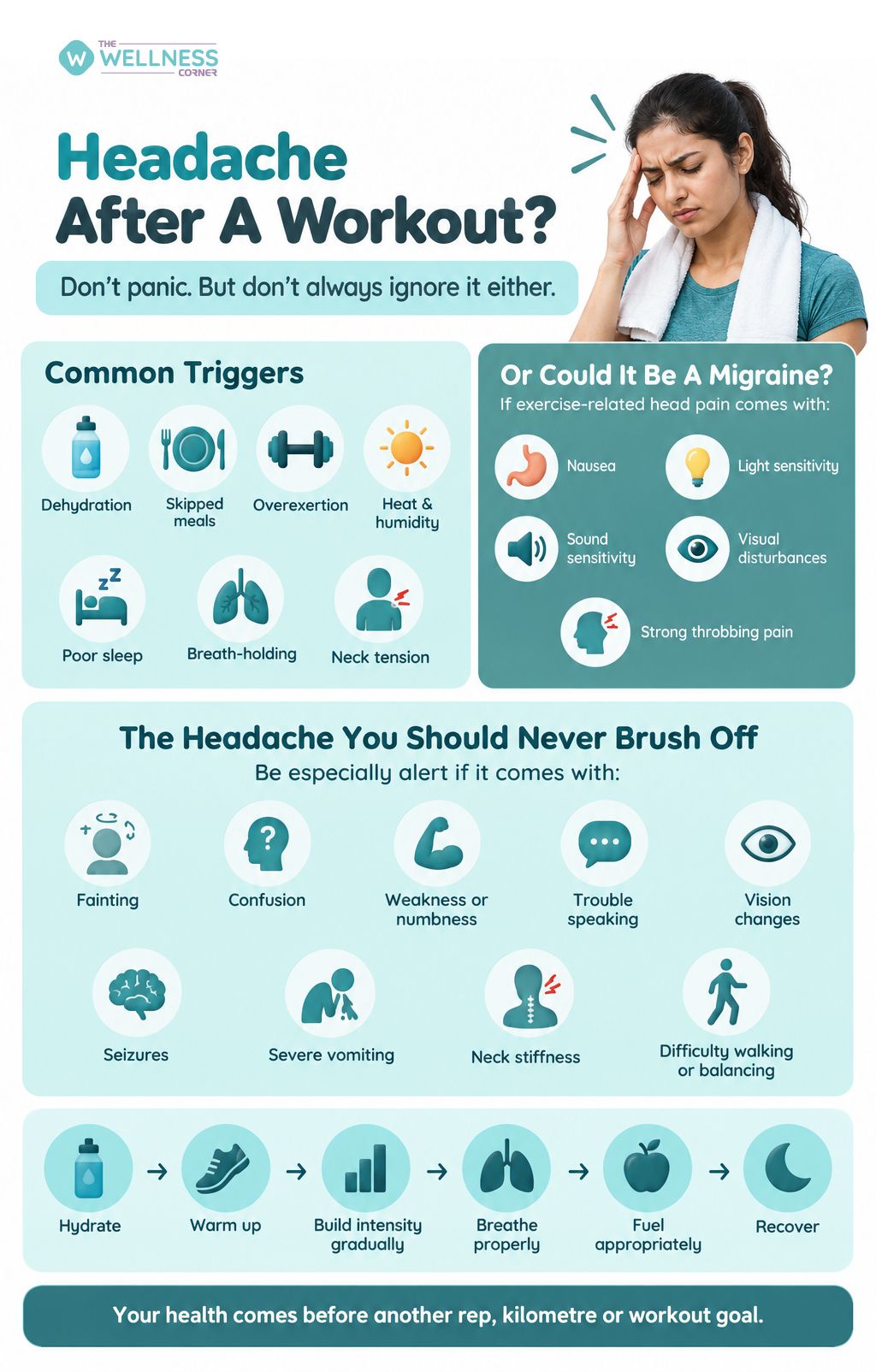
When Exercise Becomes The Trigger?
Exercise headaches, sometimes called primary exercise headaches, are headaches brought on by physical activity. They can occur during or after strenuous exercise and are more likely to appear when the body is pushed harder than usual.
Activities such as running, weightlifting, rowing, swimming, cycling, or high intensity workouts may trigger them. The pain can feel throbbing or pulsating and may affect both sides of the head.
One possible explanation is that strenuous exercise temporarily increases blood flow and pressure within blood vessels around the brain. Exactly how this occurs remains unclear at this point.
For some people, these headaches are temporary and become less frequent as their body adapts to exercise. For others, repeated episodes may need medical assessment.
Not Every Post-Workout Headache Means Something Serious
A headache after exercise can have surprisingly ordinary explanations.
Dehydration is one common possibility. Sweating causes fluid loss, and inadequate fluid intake before or during exercise may contribute to headache symptoms.
Skipping meals can also play a role. Exercising on an empty stomach or going several hours without eating may leave some people feeling weak, dizzy, or headachy.
Overexertion is another factor. Suddenly increasing your workout intensity, duration, or weight load can put additional stress on your body.
Heat, poor sleep, caffeine changes, and exercising in a hot or poorly ventilated environment may also contribute.
Sometimes, the headache is not directly caused by exercise at all. Physical activity may simply trigger a headache in someone who is already susceptible to migraines.
Also Read: 7 Sneaky Hacks To Fit A Full Workout Into Your 2026 Busy Schedule

Could It Actually Be A Migraine?
Exercise can trigger migraines in some people, particularly when combined with other triggers.
Unlike a typical exercise headache, migraine may come with symptoms such as nausea, sensitivity to light or sound, visual disturbances, or a strong throbbing sensation.
Some people may notice that intense physical activity makes an existing migraine worse. Others may develop symptoms after exercise.
This is why paying attention to the pattern matters. If headaches repeatedly occur after particular workouts and are accompanied by migraine symptoms, discussing them with a healthcare professional can help identify the likely cause.
Your Workout Technique Could Matter Too
The way you exercise can sometimes contribute to head pain.
During heavy resistance training, some people unintentionally hold their breath while lifting. This can temporarily increase pressure in the chest and affect blood pressure responses.
Poor posture may also contribute to tension in the neck and upper back, which can sometimes lead to headaches.
There’s no need to stop strength training altogether. Instead, focus on controlled breathing, proper technique, appropriate resistance, and gradual progression.
If you are new to exercise, working with a qualified fitness professional can also help you learn safe movement patterns.
Also Read - Strength Training: How Much Weight Should I Be Lifting?
The Red Flag You Should Never Ignore
There is one type of exercise-related headache that deserves particular attention: a sudden, extremely severe headache that reaches maximum intensity very quickly.
This is sometimes described as a thunderclap headache.
A sudden severe headache during or after strenuous physical activity can occasionally be associated with serious conditions involving blood vessels in or around the brain. These conditions are uncommon, but they can be medical emergencies.
Seek urgent medical attention if a severe headache occurs suddenly, particularly if it is accompanied by symptoms such as:
- Loss of consciousness or fainting
- Confusion or unusual behavior
- Weakness or numbness
- Difficulty speaking
- Vision changes
- Severe vomiting
- Neck stiffness
- Seizures
- Difficulty walking or maintaining balance
Do not assume that an unusually severe headache is simply part of having pushed yourself too hard.

When Should You Talk To A Doctor?
Even when a headache is not an emergency, recurring exercise-related headaches are worth discussing with a healthcare professional.
Make an appointment if the headaches are becoming more frequent, lasting longer than usual, getting progressively worse, or repeatedly appearing with physical exertion.
It is particularly important to seek medical advice if exercise headaches are new for you, especially if you have never experienced this type of pain before.
A doctor may ask about when the headache begins, how quickly it develops, what exercise you were doing, how long it lasts, and whether you experience other symptoms.
Depending on your symptoms and medical history, further evaluation may be recommended.
How To Reduce The Chances Of An Exercise Headache?
If your headaches have been evaluated and no serious underlying cause has been identified, a few practical habits may help.
Hydrate consistently. Drink fluids regularly instead of waiting until you become very thirsty.
Warm up gradually. Jumping straight into intense exercise may place unnecessary stress on your body. Give yourself several minutes to increase your activity level.
Build intensity slowly. Avoid suddenly doubling your workout duration or lifting significantly heavier weights.
Eat appropriately. If you tend to exercise after several hours without food, consider whether a suitable meal or snack before exercise works better for you.
Pay attention to breathing. Avoid unnecessarily holding your breath during resistance exercises.
Exercise in comfortable conditions. Excessive heat and humidity can increase physical strain and fluid loss.
Prioritize recovery. Sleep, rest days, and adequate nutrition are important parts of any training routine.
These changes will not prevent every headache, but they can address some common contributors.
Also Read: Why Drinking Water Alone Isn’t Enough To Stay Hydrated?
Keep A Simple Headache Log
If exercise headaches keep returning, tracking them can be surprisingly useful.
Write down the type of exercise you were doing, workout duration, intensity, food and fluid intake, sleep quality, environmental conditions, and when the headache started.
Also note how long the pain lasted and whether you experienced nausea, dizziness, vision changes, or other symptoms.
Patterns may emerge over time. More importantly, this information can give your healthcare professional a clearer picture of what you are experiencing.
Don't Let Fear Stop You From Moving
Experiencing a headache during exercise can understandably make you nervous about working out again. But a headache does not automatically mean that exercise is harmful for you.
For many people, the solution involves identifying triggers, improving hydration and recovery, adjusting workout intensity, or addressing an underlying headache condition.
The important point is not to ignore a new or unusual pattern simply because it happened during exercise.
Physical activity continues to be a valuable part of healthy living. The goal is to make your workouts safer and more sustainable, not to become afraid of physical activity.
Also Read: Looking For A Workout That Tones Your Body And Calms Your Mind?
Frequently Asked Questions
Are exercise-induced headaches dangerous?
Many are not caused by a serious condition, but a new, sudden, or unusually severe headache during exercise should be medically evaluated.
Why Do I Get Headaches After Weightlifting?
Heavy lifting, breath-holding, dehydration, overexertion, poor technique, or an underlying headache disorder may contribute.
Should I Exercise If I Have a Headache?
Stop exercising and seek medical attention if you develop a sudden, severe headache. For recurring but milder headaches, speak with a healthcare professional before continuing intense exercise.
The Bottom Line
Exercise-induced headaches are not necessarily a reason to give up your workouts, but they are a reason to pay attention to your body.
Mild headaches may sometimes be associated with dehydration, overexertion, skipped meals, heat, or other manageable factors. However, a sudden and severe headache, particularly one accompanied by neurological symptoms, requires urgent medical attention.
Listen to your body, increase workout intensity gradually, stay hydrated, focus on proper technique, and do not hesitate to seek professional advice when something feels unusual.
Your health should always come before another rep, another kilometre, or another workout goal. For more practical guidance on fitness, nutrition, mental wellbeing, and everyday health, explore the resources and expert support available through The Wellness Corner.
Leave a Comment

Sign-Up Now & Unlock
₹100 Cashback
Subscribe to our Newsletter!
Get a weekly dose of wellness tips delivered straight to your inbox.
Recently Published
Related Articles


Health Checks @ Home
Service
Explore



Follow us on:


© 2026 Truworth Health Technologies Pvt. Ltd.