Ego Lifting Vs. Smart Lifting: How To Outsmart The Unspoken Peer Pressure Of The Gym Room?
20 hours ago
6 minute read.

Walk into almost any gym and you will notice it: someone loading another plate onto the bar, another person pushing through an intense set, or a lifter attempting a weight that makes everyone nearby look twice. Without anyone saying a word, the atmosphere can create a subtle question in your mind: "Am I lifting enough?"
That is where gym-room peer pressure can creep in.
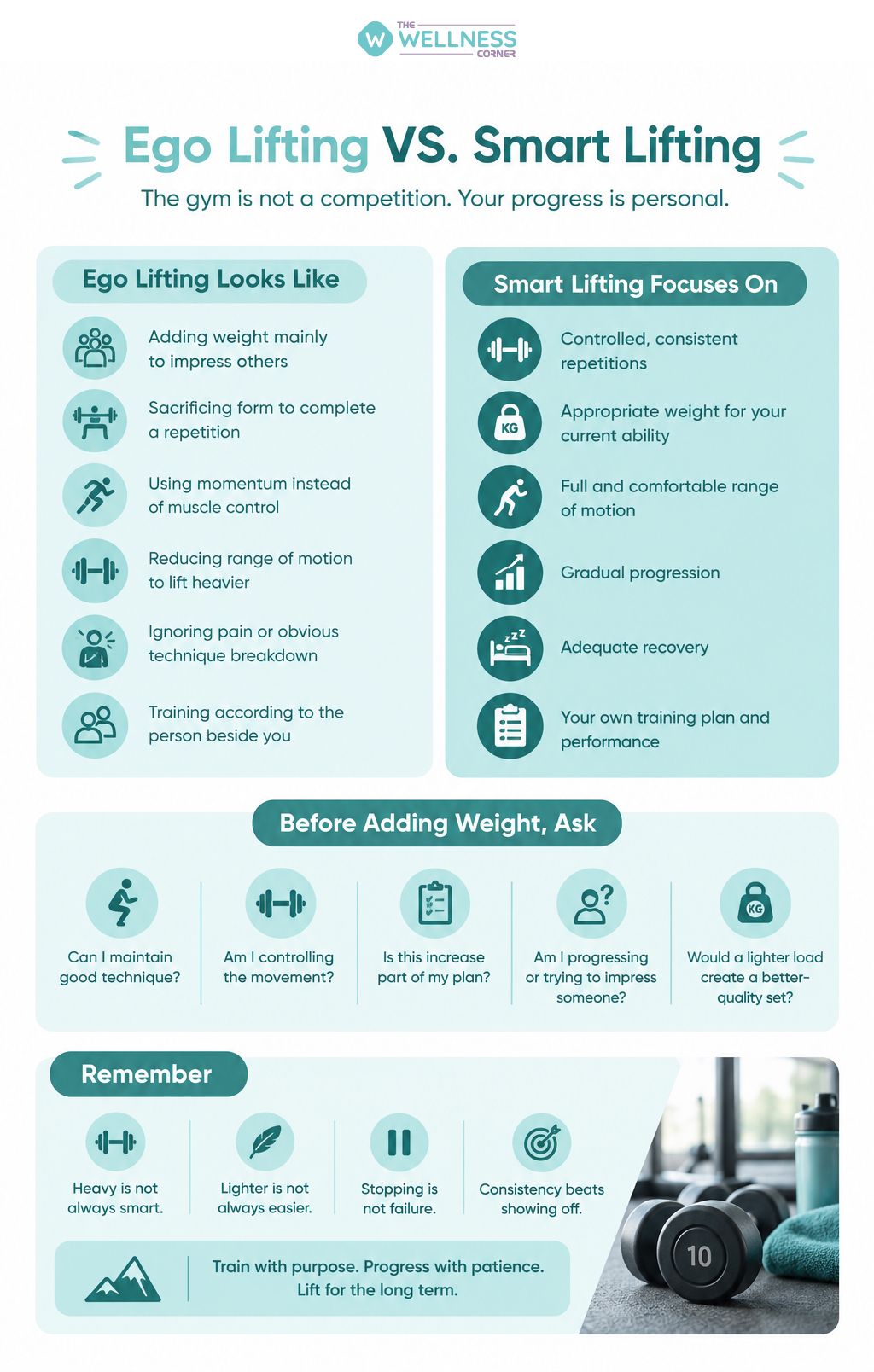
You may start adding weight simply because someone next to you is lifting heavier. You may sacrifice your technique to complete another repetition or feel embarrassed about reducing the load. This is often where ego lifting begins.
Smart lifting takes a different approach. It focuses on technique, control, progression, recovery, and long-term results rather than impressing people for a few seconds.
The strongest person in the gym is not necessarily the person moving the heaviest weight. Often, it is the person who knows when to push, when to stop, and when to put their ego aside.
Also Read: Keys To Training Safely & Lifting Heavy At Home Without A Spotter
What Exactly Is Ego Lifting?
Ego lifting happens when you choose a weight primarily to prove something rather than because it is appropriate for your current ability.
It might involve using excessive momentum during bicep curls, shortening the range of motion during squats, arching aggressively during pressing movements, or asking a training partner to help you complete most of a repetition.
There is nothing wrong with challenging yourself. Progressive overload is an important part of strength development. The problem occurs when the number on the bar becomes more important than how safely and effectively you perform the movement.
Ego lifting can turn a productive workout into a competition you never agreed to enter.
Why Does The Gym Feel Like A Competition?
Gyms are social environments. Even when everyone is focused on their own workout, you naturally notice what other people are doing.
Social comparison can influence how you judge your own performance. Seeing someone lift significantly more weight may make your current load suddenly feel inadequate, even though their training history, body size, experience, goals, and technique may be completely different from yours.
There is also an unspoken culture around strength. Heavy weights can attract attention, while controlled repetitions with lighter loads may look less impressive.
But appearance does not tell the whole story.
A technically excellent set can be far more productive than a heavier set performed with poor control.
Also Read: Ideas On What To Do On Your Gym Rest Days

The Hidden Cost Of Chasing Numbers
Adding weight can feel satisfying. Watching the plates increase can create a strong sense of progress.
But constantly chasing heavier numbers can come with trade-offs.
When the load exceeds your current capacity, you may compensate by changing your posture, using momentum, reducing your range of motion, or relying on other muscles to complete the movement.
This can reduce the quality of the exercise and make it harder to determine whether the intended muscle is actually doing the work.
More weight is not automatically more progress.
The objective should be to create an appropriate training stimulus while maintaining sound technique.
Smart Lifting Starts With Technique
Smart lifting puts movement quality ahead of appearance.
Before increasing the weight, ask yourself whether you can perform the exercise with appropriate control and a consistent range of motion.
For example, during a squat, your goal should not simply be to move the heaviest bar possible. You should be able to maintain appropriate positioning and control throughout the movement.
Similarly, during a dumbbell curl, swinging your entire body to move a heavier dumbbell may increase the number on the equipment, but it does not necessarily make the exercise more effective.
Good technique gives you a foundation for meaningful progression.
Also Read - Weightlifting Gloves: Do They Help Or Hurt Your Performance?
Learn To Separate Challenge From Recklessness
A challenging set should feel difficult. That is part of training.
The important distinction is between productive effort and unnecessary risk.
A demanding final repetition can be useful when you are maintaining appropriate technique and working within a sensible training plan. If your form starts breaking down dramatically just to complete the repetition, the weight may be too heavy.
Learning this difference takes experience.
Instead of asking, "Can I somehow lift this?" ask, "Can I lift this with good technique?"
That small change in mindset can completely alter how you approach your workouts.
Your Progress Is Not Someone Else's Progress
One of the easiest ways to fall into ego lifting is comparing your current performance with another person's.
But strength is influenced by numerous factors, including training experience, body composition, exercise selection, genetics, recovery, and consistency.
Someone who has been training for five years cannot reasonably be compared with someone who started five months ago.
Even two people with similar experience may have completely different strengths.
Your benchmark should be your own previous performance.
If you can perform an exercise with better technique, complete more controlled repetitions, improve your range of motion, or gradually increase the load without sacrificing form, that is genuine progress.
Also Read: Can You Really Turn Fat Into Muscle? A Physical Therapist Explains What Builds Strength

How To Handle Peer Pressure Without Saying A Word?
You do not need to compete with everyone around you.
If someone nearby is lifting considerably more than you, let them. Their workout is not your assignment.
Try using a simple mental rule: train according to your plan, not according to the person next to you.
You can also prepare your workout before entering the gym. Knowing which exercises, weights, sets, and repetitions you intend to perform can make you less likely to make impulsive decisions based on what others are doing.
A training log can be particularly useful because it gives you objective evidence of your own progress.
Know When To Put The Weight Down
One of the most valuable gym skills is knowing when to stop.
If your technique deteriorates, you experience sharp or unusual pain, or you cannot control the movement, continuing simply to complete the set is not a badge of honour.
Stopping a set is not failure.
It can demonstrate that you understand your limits and are prioritizing sustainable training over momentary validation.
Remember, the goal is not to survive one impressive workout. It is to keep training consistently for months and years.
Also Read: Slow Or Fast Reps? Find The Best Tempo For Your Workout Goals
Make Strength A Long-Term Game
Smart lifting is ultimately about sustainability.
You want a training approach that allows you to gradually become stronger without constantly pushing beyond your ability.
That means respecting recovery, getting adequate rest, using appropriate loads, and progressing gradually.
It also means accepting that some workouts will be stronger than others. Sleep, stress, nutrition, workload, and recovery can all influence performance.
You do not have to prove your strength every time you enter the gym.
Sometimes, the smartest workout is the one where you leave knowing you trained well and still have enough energy to recover.
A Simple Ego-Lifting Check
Before adding another plate, ask yourself:
- Can I maintain good form?
- Am I completing the intended range of motion?
- Am I controlling the weight rather than throwing it around?
- Is this increase part of my training plan?
- Am I adding weight because I need to progress or because someone is watching?
- Would a slightly lighter load produce better-quality repetitions?
If the honest answer points toward ego, take the weight down.
There is no audience scorecard in the gym.
The Bottom Line
The gym does not need to become a competition.
Ego lifting may provide a temporary feeling of accomplishment, but smart lifting focuses on something much more valuable: consistent, sustainable progress.
Choose weights that challenge you without forcing your technique to fall apart. Track your own improvements, respect your limits, and remember that another person's numbers have nothing to do with your fitness journey.
Real strength is not just about how much you can lift. It is also about having the discipline to lift intelligently.
Ready to build healthier and more sustainable fitness habits? Explore The Wellness Corner for practical insights on exercise, nutrition, recovery, and overall wellbeing.
FAQs
Leave a Comment

Sign-Up Now & Unlock
₹100 Cashback
Recently Published
Related Articles


Health Checks @ Home
Service
Explore



Follow us on:


© 2026 Truworth Health Technologies Pvt. Ltd.