“Natural”, “Organic”, “Multigrain”: Learn The Differences In Food Claims
0 months ago
6 minute read.

Walk through a supermarket aisle and you will notice something interesting. Food packets are competing for your attention before you even look at the ingredients.
Natural. Organic. Multigrain. Whole grain. High protein. No added sugar.
Attractive as these claims may sound, each refers to something different.
In fact, one of the easiest ways to make better food choices is to stop treating attractive words on the front of a package as a complete health report. Some claims describe how food is produced. Others describe what ingredients a product contains. Some may refer to a specific nutritional characteristic.
Understanding the difference can help you shop more confidently without becoming obsessed with every number on the nutrition label.
So, the next time a packet says “natural,” “organic,” or “multigrain,” what should you actually take from it?
Also Read: Baked Multigrain Palak Matris
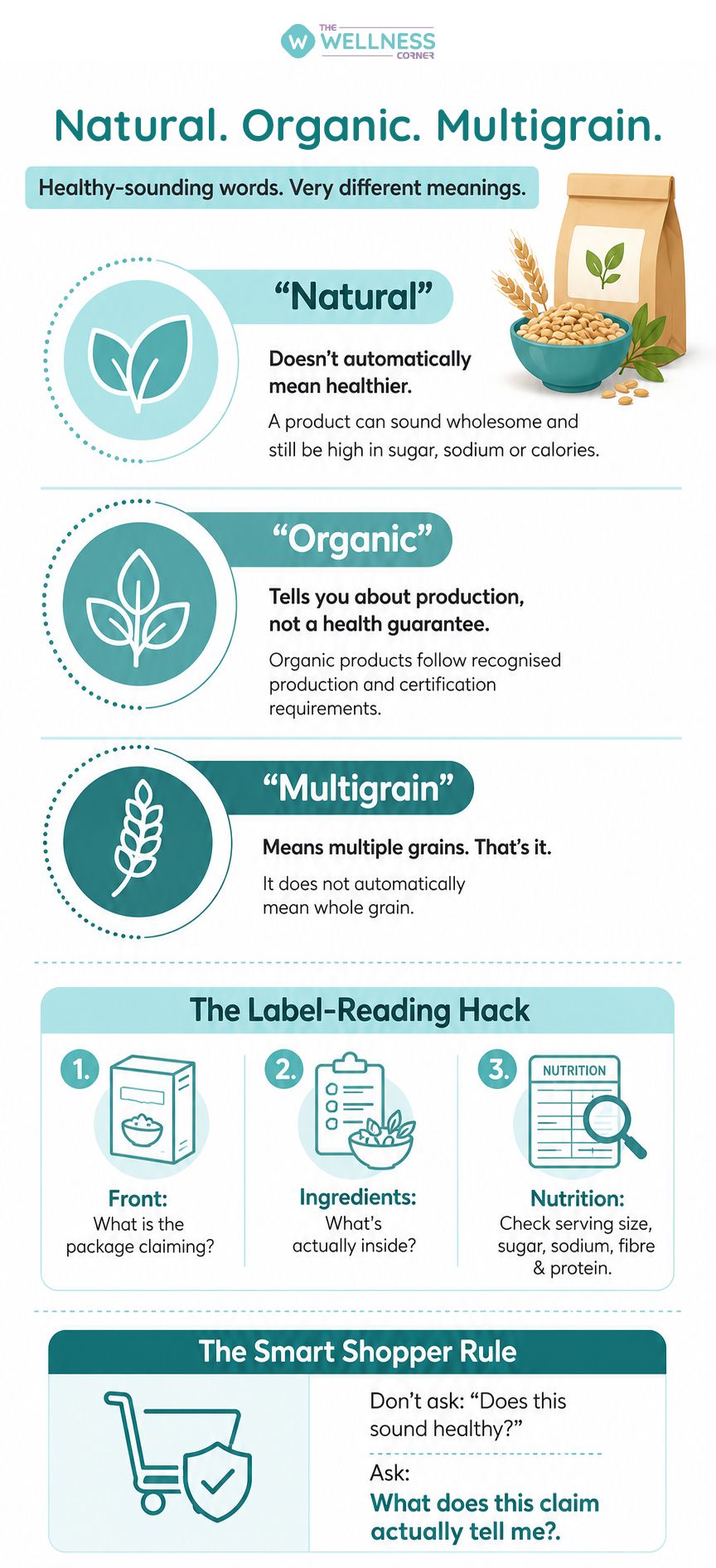
“Natural” Does Not Automatically Mean Healthier
“Natural” is one of the most persuasive words in food marketing because it creates an instant image of simple, wholesome ingredients.
But natural does not automatically mean nutritious.
The exact interpretation of “natural” can depend on the regulatory framework and how the claim is presented. In India, FSSAI requires food claims to be truthful, meaningful, unambiguous and not misleading. It also specifically addresses situations where brand names containing terms such as “natural,” “fresh,” “pure” or “traditional” could mislead consumers.
That means the word itself should not make the entire purchasing decision for you.
A product can contain naturally derived ingredients and still be high in sugar, sodium or calories.
What should you check?
Instead of asking only, “Is it natural?”, also look at:
- The ingredient list
- Serving size
- Sugar content
- Sodium
- Fibre
- Protein
- Overall nutritional value
The first few ingredients are especially useful because packaged food ingredients are generally listed by weight, from highest to lowest.

“Organic” Tells You How Food Is Produced
Organic is different.
In India, organic food products are governed by the requirements set out in the Food Safety and Standards (Organic Foods) Regulations, 2017. FSSAI recognises the National Programme for Organic Production, or NPOP, and the Participatory Guarantee System, or PGS-India, for organic certification.
So when a product is legitimately certified organic, the claim is connected to defined production and certification requirements.
But there is an important catch.
Organic does not automatically mean low calorie, low sugar or nutritionally superior.
An organic biscuit is still a biscuit. An organic sweetened cereal can still contain considerable sugar.
Organic tells you something important about the production system, but you still need to consider the food's overall nutritional profile.
How Can You Tell If Organic Claims Are Genuine?
For consumers in India, certification marks can provide useful clues.
The Jaivik Bharat guidance says consumers should look for relevant certification information. Depending on the certification system, labels can include the FSSAI logo and licence number, the India Organic logo, certification body details or PGS-India identification.
For NPOP-certified multi-ingredient products, FSSAI's consumer guidance states that at least 95% of ingredients must be of certified organic origin for the product to be labelled “Certified Organic.” PGS-India has a similar 95% requirement for mixed or processed products.
So instead of trusting a large green “organic” message alone, check the certification information too.
Also Read: Eating Organic On A Budget

“Multigrain” Means Multiple Grains, Not Necessarily Whole Grains
Now comes one of the most common sources of confusion.
Multigrain does not automatically mean whole grain.
A multigrain product contains more than one grain, but that does not by itself tell you whether those grains are whole or refined.
Whole grains contain the major components of the grain, including the bran, germ and endosperm. Refined grains are processed differently and typically lose the bran and germ.
That distinction matters when you are choosing bread, flour, cereals or other grain-based foods.
A packet shouting “multigrain” may sound healthier, but the ingredient list gives you a better idea of what those grains actually are.
India Has Specific Standards For Multigrain Foods
The term multigrain is not always just marketing language. Certain food categories have specific FSSAI standards.
For example, FSSAI's standards for multigrain atta describe it as a blend based on whole wheat and other permitted ingredients, with whole wheat making up 50% to 90% of the flour composition. The standard also requires the percentage of wheat flour to be declared on the label.
There are also defined standards for bread.
Under FSSAI's bread nomenclature requirements, whole wheat bread must contain at least 75% whole wheat flour, while multigrain bread must contain at least 20% grains other than wheat.
This is why reading the exact product category matters.

Multigrain And Whole Grain Are Two Different Questions
Consider two labels.
Multigrain bread
versus
Whole wheat bread
They may sound similar, but they communicate different information.
Multigrain tells you there are multiple grains involved.
Whole wheat tells you something more specific about the grain ingredient.
This does not mean one label automatically makes a product healthier than another. The rest of the ingredient list and nutrition information still matter.
A smarter question is:
“What grains are actually in this product, and in what form?”
Do Not Let One Healthy-Sounding Word Create A “Health Halo”
Ever bought something because the packet said “natural” or “multigrain” and automatically assumed it was the healthier option?
That is the health halo effect.
One positive-sounding characteristic can make us overlook the rest of the label.
For example:
A multigrain snack may still be high in salt.
An organic dessert may still be high in sugar.
A natural beverage may still contribute significant calories or sugars.
This does not mean these products are automatically unhealthy. It simply means one claim should not replace the full picture.
FSSAI's regulations are designed specifically to prevent food claims from becoming misleading or confusing for consumers.

A Simple Three-Step Label Reading Habit
You do not need to spend ten minutes examining every packet.
Try this quick routine instead.
1. Read The Front
Notice what the manufacturer wants you to see.
Is it natural? Organic? Multigrain?
Treat this as the starting point, not the final answer.
2. Turn The Packet Around
Look at the ingredient list.
What appears first? Which grains are actually present? Are sugar, salt or refined ingredients among the major components?
3. Check The Nutrition Information
Compare serving size, calories, protein, fibre, sugars and sodium.
This gives you a much more useful picture of what you are buying.
Also Read: The Indian Thali Is Already A Superfood - Here’s Why You Overthink Nutrition!
The Best Food Claim Is The One You Understand
There is no need to become suspicious of every food label.
“Natural” can provide useful information in the appropriate context. “Organic” can tell you about certified production practices. “Multigrain” can indicate the presence of several grains.
The problem begins when we turn these words into shortcuts for “healthy.”
A better approach is to ask what the claim actually tells you.
Natural: What does this claim mean for this specific product?
Organic: Is the product appropriately certified?
Multigrain: Which grains are included, and are they whole or refined?
That small shift can make grocery shopping much more informed.

The Bottom Line
Food packaging is designed to catch your attention. Your job as a consumer is to look beyond the headline.
Natural is not automatically healthier. Organic describes production standards, not a blanket health guarantee. Multigrain means multiple grains, but it does not automatically mean whole grain.
The smartest food choices come from combining the front-of-pack claim with the ingredient list and nutrition information.
Because sometimes, the most important information on a food packet is not the biggest word.
Make Smarter Nutrition Choices With The Wellness Corner
Understanding food labels is one part of building healthier everyday habits. For practical nutrition resources, healthy eating guidance and lifestyle information, explore The Wellness Corner and make more informed choices for yourself and your family.
FAQs
Leave a Comment

Sign-Up Now & Unlock
₹100 Cashback
Recently Published
Related Articles


Health Checks @ Home
Service
Explore



Follow us on:


© 2026 Truworth Health Technologies Pvt. Ltd.