Face Serum Vs Moisturiser: Which One Do You Really Need?
1 month ago
6 minute read.
Walk into any skincare store today and you can easily feel overwhelmed. There are hydrating serums, brightening serums, vitamin C serums, moisturisers for oily skin, creams for dry skin, gel moisturisers, barrier creams and countless products promising smoother, brighter, younger-looking skin.
So, where does that leave you?
Do you really need both a face serum and a moisturiser? Or is one enough?
The answer depends largely on what your skin needs and what you want your skincare routine to achieve. A serum and a moisturiser are not interchangeable products. They generally serve different purposes, and using both can make sense when each addresses a specific need. Dermatologists also recommend keeping skincare routines targeted and avoiding unnecessary layering, since using too many products can increase the chance of irritation.
Let's break down the difference so you can decide what actually belongs in your routine.
Also Read: Effective Homemade Moisturizers For Dry Skin
First, What Does A Face Serum Actually Do?
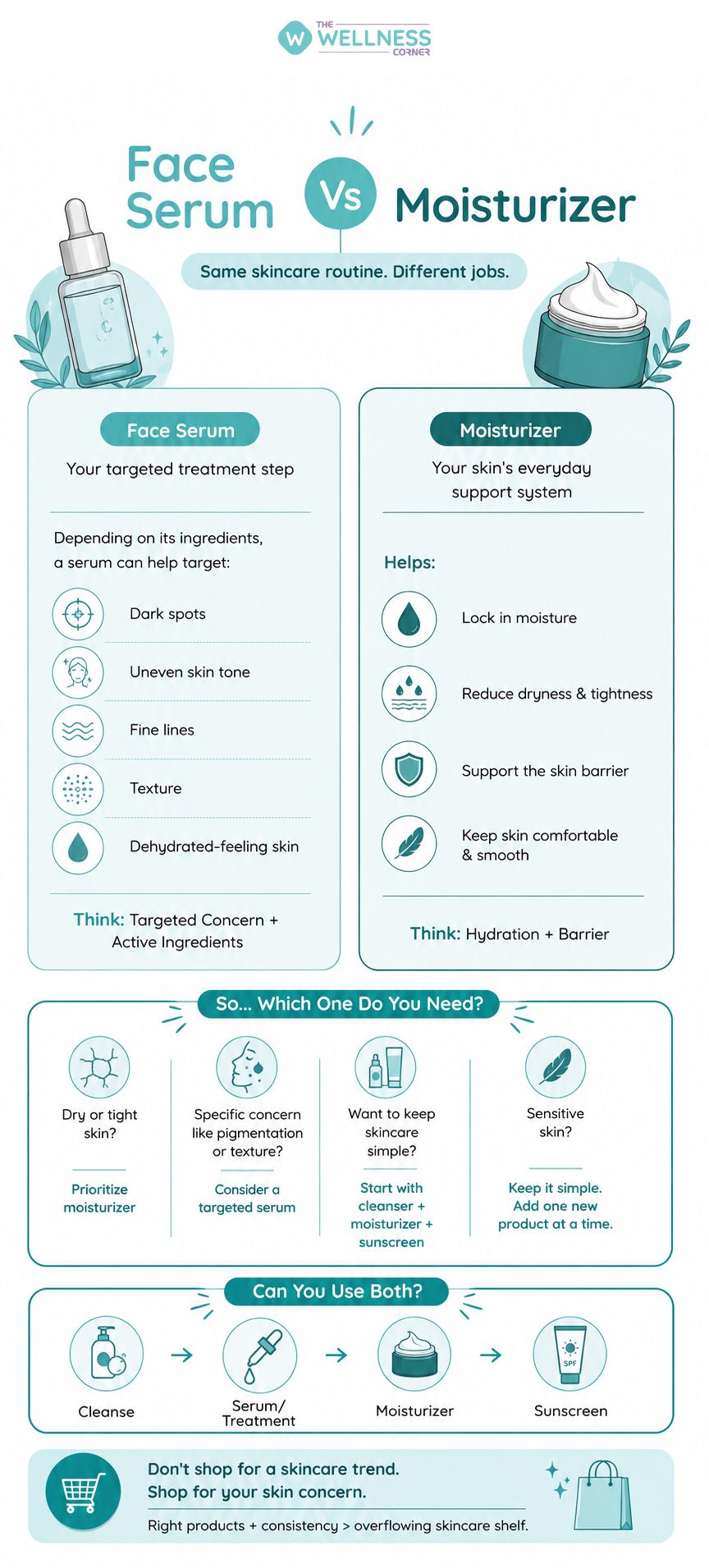
A serum can provide focused care for specific skin concerns and goals.
Serums are usually formulated around specific ingredients intended to address particular skin concerns. Depending on the formula, they may contain ingredients such as vitamin C, niacinamide, hyaluronic acid, retinoids or exfoliating acids.
For example, the American Academy of Dermatology notes that vitamin C can help address dark spots and signs of skin ageing, while retinoids can help with acne, uneven skin tone, fine lines and skin texture.
That means a serum can be useful when you have a specific concern you want to work on.
Common serum goals include:
- Supporting hydration
- Improving the appearance of uneven skin tone
- Addressing dark spots
- Supporting smoother-looking skin
- Managing certain acne-related concerns
- Helping reduce the appearance of fine lines and wrinkles
The important word here is targeted.
You do not need a serum simply because skincare trends tell you that you should have one.

Then What Is Moisturiser Supposed To Do?
A moisturiser has a more foundational role.
Rather than focusing primarily on one specific cosmetic concern, moisturisers help keep the skin hydrated and support the skin barrier. Applying moisturiser after washing can help trap existing moisture in the skin. For dry or irritated skin, dermatologists may recommend richer creams or ointments rather than lightweight lotions.
This is why moisturiser can be useful even when you do not have a major skin concern.
Your skin does not need to be visibly dry before you think about hydration.
Moisturiser can help:
- Reduce dryness and tightness
- Support the skin barrier
- Improve skin comfort
- Reduce the appearance of dry, flaky areas
- Make skin feel softer and smoother
So, while serum often answers the question "What specific skin concern am I trying to address?", moisturiser answers "How can I support my skin's everyday hydration and barrier?"
Also Read: Reasons You Should Not Skip Moisturizer
Serum Vs Moisturiser: The Difference In One Look
The easiest way to understand the distinction is to think of them as different jobs.
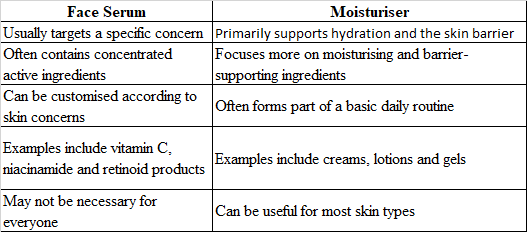
The exact formulation matters, though. Products vary widely, so the label and ingredients are more important than whether something is simply called a "serum" or "moisturiser."
So, Do You Actually Need A Serum?
Not necessarily.
For someone who wants a simple skincare routine, a gentle cleanser, moisturiser and sunscreen may be a more useful starting point than buying several specialised products. The AAD recommends daily sunscreen and a mild cleanser as core skincare practices, while targeted products can be added depending on individual concerns.
You may consider adding a serum when you have a clear reason to use one.
For example, you may want to address:
Dark spots: A vitamin C product may be considered as part of a routine targeting uneven pigmentation.
Fine lines or texture: Retinoid products can be used for certain signs of ageing and texture concerns.
Dehydrated-feeling skin: A hydrating serum can add another layer of moisture, depending on the formulation.
The key is to choose the ingredient based on the concern, rather than buying a serum because it is currently popular.
Also Read: 5-Minute Skincare Routine For Busy Corporate Girls
When Moisturiser Matters More Than Serum?
If your main concern is dryness, tightness, irritation or a compromised skin barrier, moisturiser may deserve more attention than a serum.
This is particularly relevant during colder or drier weather, when skin may lose moisture more easily. The AAD recommends applying moisturiser immediately after washing to help retain moisture, and notes that creams and ointments can be more effective for very dry skin.
There is also an important misconception worth clearing up.
Oily skin does not automatically mean you should skip moisturiser.
Even acne-prone or oily skin may benefit from moisturising. The better approach is to choose a formulation suited to your skin type, such as a lighter, non-comedogenic product when appropriate.

Can You Use Both Serum And Moisturiser?
Yes.
For many people, the two products can work well together.
A common approach is:
Cleanser → Serum or treatment → Moisturiser → Sunscreen in the morning
The AAD generally recommends applying skincare treatments after cleansing, followed by moisturiser and/or sunscreen.
The serum provides the targeted treatment, while the moisturiser helps support hydration.
At night, your routine may look different depending on the products you use. For example, some retinoid treatments are typically used at night and may require adjustments if they cause dryness or irritation.
Also Read: Does Sunscreen Expire? 3 Signs + What Expired Sunscreen Does To The Skin
What If You Have Sensitive Skin?
A longer skincare routine is not necessarily a better one, especially for sensitive skin.
Adding several active ingredients at the same time makes it difficult to know which product is helping and which one may be causing irritation.
The AAD recommends introducing products thoughtfully and notes that using multiple anti-ageing products within a short period can irritate the skin.
If you have sensitive skin, keep your routine simple at first:
Gentle cleanser + suitable moisturiser + sunscreen
Then introduce one targeted product at a time when there is a genuine reason to do so.
If a product causes persistent burning, itching, redness or irritation, stop using it and consider speaking with a dermatologist.
Also Read: How Do I Know If I Have Sensitive Skin?
Which One Should You Buy First?
If your skincare shelf is already overflowing, you probably do not need another five products.
Start with your biggest need.
If your skin feels dry or tight: Prioritise moisturiser.
If you have a specific concern such as pigmentation or texture: Consider a targeted serum.
If you want a simple everyday routine: Start with cleanser, moisturiser and sunscreen before adding extras.
If your skin is sensitive: Keep things simple and introduce new products slowly.
And remember, an expensive product is not automatically a better product. Dermatologists emphasise choosing products suited to your skin type and having realistic expectations about what skincare can achieve.
The Biggest Skincare Mistake? Doing Too Much
The skincare industry can make it seem as though a perfect routine requires ten or fifteen steps.
It doesn't.
A routine you can follow consistently is often more practical than a complicated shelf full of products that you rarely use. The AAD highlights consistency as an important part of skincare and cautions that constantly changing products can lead to irritation rather than better results.
Not every popular skincare ingredient is necessary for your skin.
It needs the right products for your skin and your concerns.
The Bottom Line
So, face serum or moisturiser?
For most people, it is not really an either-or decision.
Moisturiser is a foundational skincare product that helps maintain hydration and support the skin barrier. A serum is usually an optional, targeted step designed around a particular skin concern.
Using both products is an option, not a skincare requirement.
Start with the basics, understand what your skin actually needs, introduce targeted products thoughtfully, and resist the temptation to copy someone else's ten-step routine.
Effective skincare is not about filling your shelf with countless products.
The real difference comes from using suitable products consistently.
Build A Smarter Skincare Routine With The Wellness Corner
Healthy skin is part of overall wellbeing, and good skincare starts with understanding your individual needs rather than following every new trend. For practical wellness information, healthy lifestyle resources and expert guidance, explore The Wellness Corner and make informed choices that work for you.
FAQs
Leave a Comment

Sign-Up Now & Unlock
₹100 Cashback
Recently Published
Related Articles


Health Checks @ Home
Service
Explore



Follow us on:


© 2026 Truworth Health Technologies Pvt. Ltd.