Slow Or Fast Reps? Find The Best Tempo For Your Workout Goals
9 months ago
5 minute read.

Mastering the pace that transforms your training results
The Power Of Tempo: Why Speed Matters More Than You Think?
When it comes to strength training, most people focus on the obvious: sets, reps, and weight. But there’s a hidden factor that can dramatically change your results - tempo.
Tempo refers to the speed at which you perform each phase of a repetition, lowering the weight (eccentric), lifting it (concentric), and even pausing in between. Whether you move slowly and controlled or fast and explosive, your rep speed influences how your muscles grow, strengthen, and adapt.
So, which is better - slow reps or fast reps? The truth is, both have their place. The right tempo depends on your fitness goal, whether that’s building strength, burning fat, improving endurance, or increasing muscle size. Let’s break it down.
Also Read: Simple Ways To Tell If Your Workout Routine Is Actually Effective
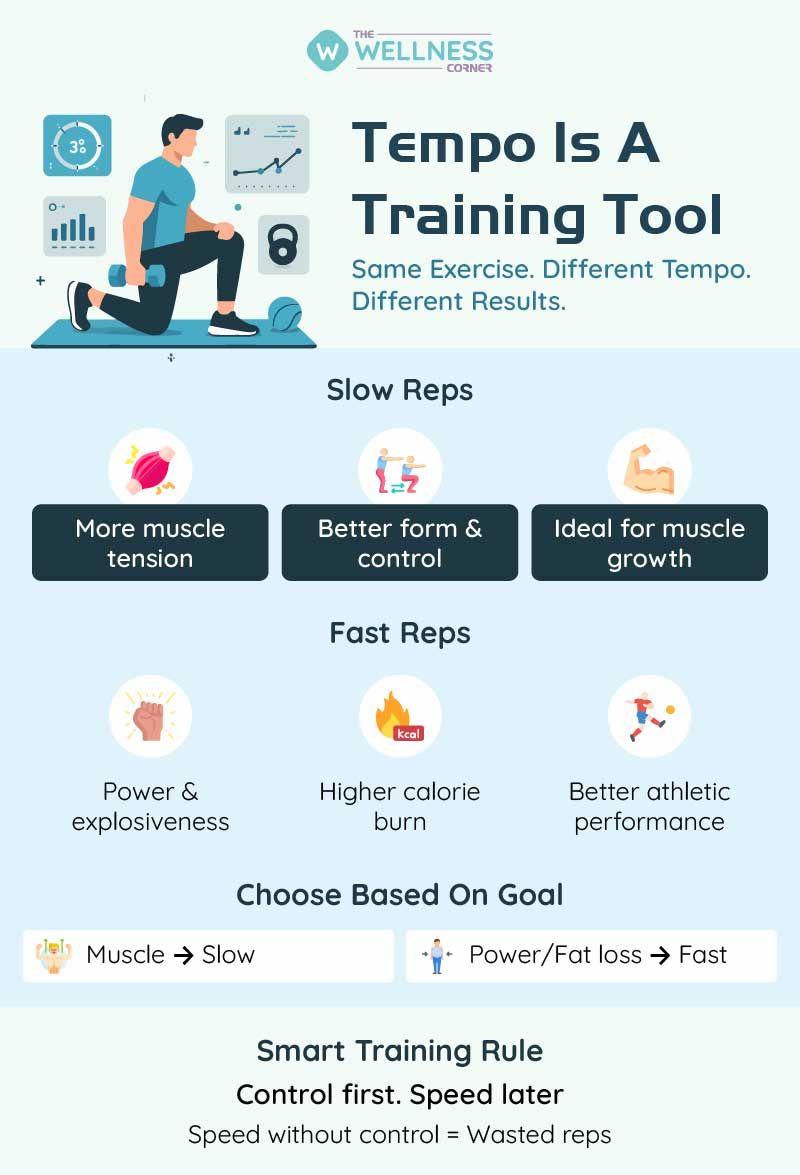
Slow Reps: The Science Of Time Under Tension
Ever tried lifting slowly, feeling every muscle fiber working with precision? That’s called time under tension (TUT) - and it’s the key to muscle growth.
When you perform slow reps, your muscles stay engaged longer, creating more micro-tears in the fibers. This controlled tension triggers hypertrophy, the process responsible for muscle size increase.

Benefits Of Slow Reps
- Better muscle control: You focus on form, reducing the risk of injury.
- Increased muscle activation: Especially in the eccentric (lowering) phase.
- Improved mind-muscle connection: You feel the muscle working through every inch of movement.
- Ideal for hypertrophy and toning: Great for shaping lean, defined muscles.
Example:
If you’re doing a bicep curl with a 3-1-2 tempo (three seconds down, one-second hold, two seconds up), your muscles are active for six full seconds per rep - double the tension of quick reps.
Slow reps are particularly useful for bodybuilders, those recovering from injuries, or anyone focused on aesthetics rather than raw strength.
Fast Reps: Building Power And Performance
Now imagine the opposite, you’re lifting explosively, pushing the weight up with speed and energy. That’s where fast reps shine.
Fast repetitions recruit fast-twitch muscle fibers, the ones responsible for strength, speed, and power. This tempo mimics the kind of movement used in sports and
functional activities, helping improve athletic performance and calorie burn.
Also Read: Strength Training: How Much Weight Should I Be Lifting?
Benefits Of Fast Reps
- Enhanced muscle power: Perfect for athletes and high-intensity training.
- Improved neuromuscular coordination: Your brain and muscles communicate more efficiently.
- Greater calorie burn: The explosive nature keeps your heart rate up.
- Ideal for endurance and fat loss: You engage more muscles in less time.
Example:
A bench press at a 1-0-1 tempo (one second down, no pause, one second up) focuses on speed and explosiveness. It’s great for those working on strength, agility, or HIIT-style workouts.
However, fast reps demand perfect form - moving quickly doesn’t mean moving carelessly. Momentum should never replace control.
Which Tempo Is Right For You?
Let’s match rep speed with your fitness goals.
|
Goal |
Recommended
Tempo |
Focus |
|
Muscle growth (hypertrophy) |
3-1-2 or 4-0-2 |
Longer time under tension |
|
Strength and power |
1-0-1 or 2-0-1 |
Explosive concentric phase |
|
Endurance and fat loss |
2-0-2 |
Moderate, controlled tempo |
|
Injury prevention / rehab |
3-1-3 |
Controlled, balanced movement |
|
Athletic performance |
1-0-1 |
Fast-twitch fiber activation |
Tip: Mix both tempos in your training cycle. Slow reps can improve control and muscle activation, while fast reps can build power and agility. The combination gives you a well-rounded, adaptable body.
The Role Of Mind-Muscle Connection
No matter your tempo, what truly amplifies your results is the mind-muscle connection - being mentally present and aware of the muscle you’re targeting.
When performing slow reps, focus on squeezing the muscle through the entire range of motion. With fast reps, stay mindful of your breathing, control, and core engagement. This conscious awareness makes every repetition more effective and reduces injury risk.
Common Mistakes To Avoid
Even the best tempo won’t work if your technique falters. Here are a few common errors people make:
1. Using Momentum Instead Of Muscle Control
Swinging weights too fast turns your workout into a momentum exercise, not a strength one.
2. Ignoring Form When Lifting Heavy
Lifting too heavy at a fast tempo can strain joints and muscles.
Also Read: 4 Things You Wish You Knew Before Starting Lifting Weights
3. Skipping Warm-Ups And Cooldowns
No matter how strong or fast you go, your muscles need proper preparation and recovery.
4. Not Varying Your Tempo
Doing the same rep speed every time leads to plateaus. Periodically switch it up to challenge your muscles in new ways.
How To Experiment With Tempo?
If you’re new to tempo training, start small.
- Pick one exercise per session (say, squats or push-ups) and focus on slowing it down.
- Record your performance. Slower reps should feel harder even at lighter weights.
- Add fast reps once you’re comfortable with control - especially for compound moves like deadlifts, rows, or presses.
Try alternating between slow and fast days each week. This keeps your body guessing and maximizes your training results.
Real-Life Example: The Squat Tempo Trick
Let’s take a simple exercise like the squat.
Slow-Tempo Squat
Lower yourself for 3 seconds, pause for 1 second at the bottom, and rise in 2 seconds. You’ll feel your quads, glutes, and hamstrings burn as you build stability and control.
Fast-Tempo Squat
Descend quickly (1 second) and rise explosively (1 second). This builds leg power and mimics athletic movements like sprinting or jumping.
Both are beneficial - the difference lies in what you’re training for.
Also Read: Can’t Squat? Here Are 3 Alternatives!

The Science Behind Tempo Training
Studies show that muscles don’t just respond to load; they respond to tension duration. A longer time under tension increases muscle damage (in a good way), while explosive movements improve neural efficiency and muscle firing rates.
For example, research in the Journal of Strength and Conditioning Research found that slower reps (4 seconds eccentric) increased hypertrophy, while faster reps enhanced strength and speed performance.
So, the real secret is understanding how to use both strategically.
The Takeaway
Tempo isn’t just a detail; it’s a powerful tool. Slow reps sculpt and strengthen, while fast reps energize and empower. Together, they form the foundation of a complete, effective workout routine.
If your progress has stalled or your workouts feel monotonous, adjusting your tempo might be the missing piece. Remember, your body adapts to what you repeatedly do, so give it a reason to evolve.
A Great Read: Looking For A Workout That Tones Your Body And Calms Your Mind?
Build Smarter Workouts With The Wellness Corner
Want expert guidance on how to optimize your workout tempo, strength training, and recovery? The Wellness Corner App connects you with certified fitness coaches and nutritionists who tailor plans to your unique goals.
Get real-time feedback, personalized programs, and actionable insights designed to help you train smarter - not just harder.
Take your fitness to the next level.
Visit The Wellness Corner and start your customized fitness journey today!
Leave a Comment

Sign-Up Now & Unlock
₹100 Cashback
Recently Published
Related Articles


Health Checks @ Home
Service
Explore



Follow us on:


© 2026 Truworth Health Technologies Pvt. Ltd.