The Reverse Workout: How Less Exercise Could Lead To Better Fitness Results?
2 months ago
7 minute read.

For years, fitness culture has celebrated the idea that more is always better.
- More workouts.
- More sweat.
- More miles.
- More intensity.
Many individuals believe that reaching their fitness goals requires continually increasing their effort and dedicating more and more time to exercise.
Social media frequently strengthens this belief by showcasing nonstop fitness challenges, high-intensity workout routines, and dramatic transformation stories that appear to celebrate relentless effort.
But what if doing less could sometimes produce better results?
This idea may sound counterintuitive, yet an increasing number of fitness professionals are discussing the importance of recovery, balance, and sustainable training.
The concept often referred to as the "reverse workout" is not about avoiding exercise. Instead, it focuses on understanding that strategic rest, recovery, and moderation may play a significant role in improving fitness outcomes.
Sometimes, the smartest move is not adding another workout but allowing your body the time it needs to adapt and recover.
Also Read: Why You Keep Quitting Your Workouts? (And the 5-Minute Fix To Stay On Track)
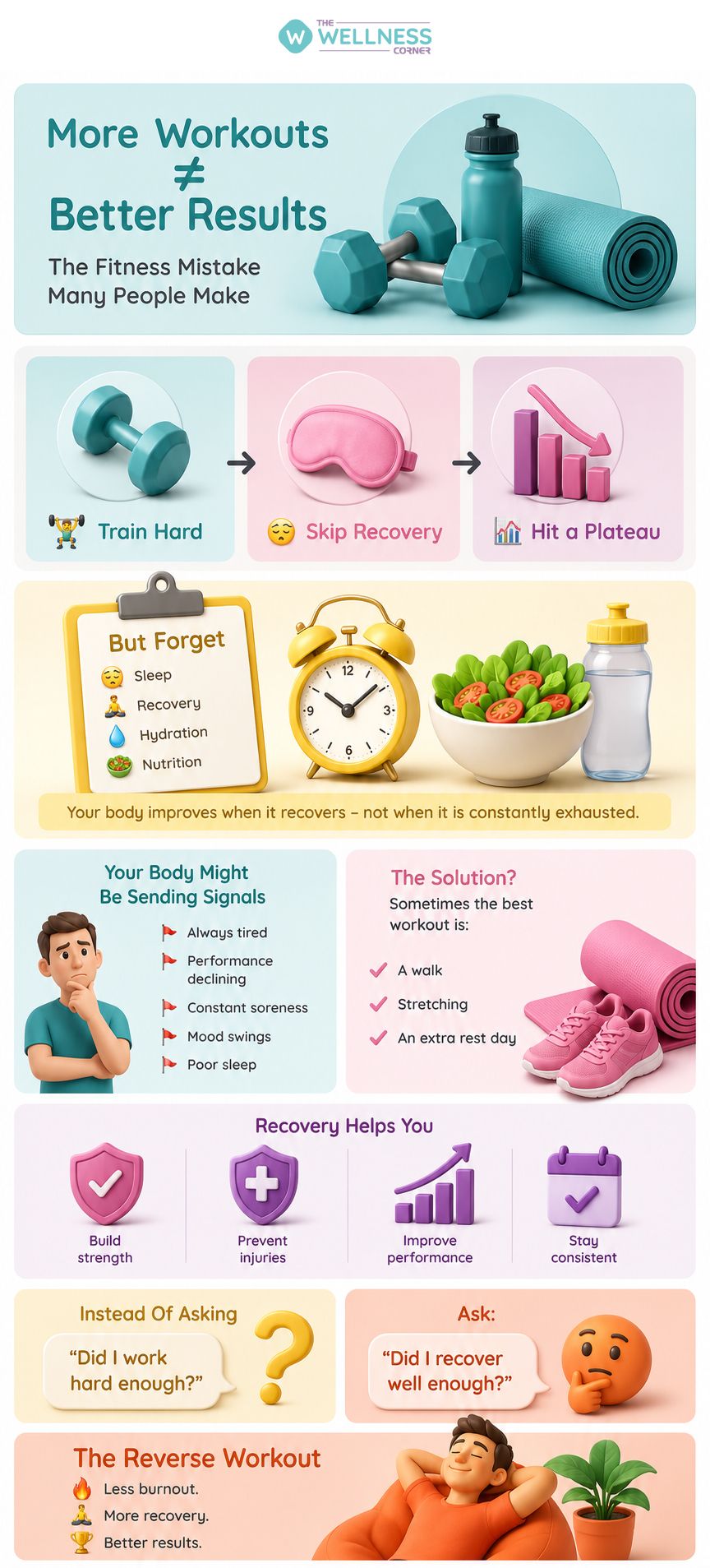
What Is the Reverse Workout?
The reverse workout is not a specific exercise routine.
Rather, it is a mindset that challenges the belief that maximum effort every day is the only path to success.
The concept emphasizes:
- Recovery
- Rest days
- Balanced training
- Listening to the body
- Avoiding unnecessary overtraining
- Long-term sustainability
Instead of constantly increasing exercise volume, the reverse workout approach recognizes that fitness improvements often occur during recovery periods rather than during the workout itself.
Exercise provides the stimulus.
Recovery allows adaptation.
Both are essential.
Why More Exercise Is Not Always Better?
Many people assume that doubling workout time will double fitness results.
Unfortunately, the human body does not always work that way.
Exercise places stress on muscles, joints, connective tissues, and the nervous system.
If the body does not receive sufficient time to recover, it may find it difficult to adapt effectively to the physical demands being placed upon it.
Excessive training can sometimes contribute to:
- Persistent fatigue
- Reduced performance
- Poor recovery
- Increased injury risk
- Sleep disturbances
- Loss of motivation
- Mood changes
This does not mean exercise is harmful.
It simply highlights that meaningful progress is often achieved when periods of hard work are balanced with adequate recovery and rest.
Also Read: Should You Exercise When You’re Sleep-Deprived?

The Science Behind Recovery
When you exercise, your body experiences temporary stress.
Muscle fibers undergo microscopic changes.
Energy stores become depleted.
The nervous system works harder.
During recovery, the body begins repairing and adapting to those demands.
This process may support:
- Muscle growth
- Strength development
- Improved endurance
- Enhanced mobility
- Better performance
Put simply, recovery should be viewed as an essential part of the fitness process rather than time away from it.
Recovery is part of fitness.
Why Rest Days Are Often Underrated?
Many people feel guilty when they skip a workout.
Some even view rest as laziness.
In reality, rest days serve several important functions.
They may help support:
- Muscle repair
- Hormonal balance
- Joint recovery
- Mental refreshment
- Energy restoration
- Injury prevention
Without adequate recovery, exercise may become less effective over time.
Athletes at every level recognize that strategic recovery is often essential for long-term performance.
Also Read - The Injury Prevention Checklist: 10 Moves Every Lifter Needs To Stop Pain Before It Starts
The Hidden Risks Of Overtraining
Overtraining can occur when the demands placed on the body consistently exceed its ability to rest, repair, and recover effectively.
While severe overtraining is relatively uncommon, many people experience milder forms of excessive training.
Possible signs include:
- Constant soreness
- Declining workout performance
- Difficulty sleeping
- Persistent fatigue
- Reduced enthusiasm for exercise
- Frequent illnesses
- Irritability
- Poor concentration
These symptoms may indicate that the body needs more recovery rather than more exercise.

Why Recovery Supports Better Results?
Many people expect fitness improvements to occur in a steady and continuous manner without fluctuations or setbacks.
Many people perceive fitness progress as a smooth and consistently upward path without setbacks or pauses.
Many people expect their fitness journey to follow a consistent upward trend, with progress happening steadily over time.
Work harder.
Get better.
Repeat.
In reality, adaptation often happens in cycles.
The body performs best when demanding periods of training are balanced with adequate time for rest and recovery.
This recovery allows the body to:
- Rebuild tissues
- Restore energy reserves
- Adapt to training demands
- Prepare for future workouts
Without recovery, the body may never fully realize the benefits of training.
Also Read: Fitness Myths Women Still Hear In 2026
The Role Of Sleep In The Reverse Workout
Quality sleep is one of the body's most effective tools for recovery and restoration.
Quality sleep is one of the body's most valuable resources for recovery and repair.
Yet it is often overlooked.
While you sleep, the body carries out a variety of important processes that support healing, repair, and overall recovery.
While you sleep, the body engages in a range of vital processes that help promote healing, repair, and recovery.
Imagine someone who works out intensely 7 days a week but sleeps only 5 hours a night. Compare that to someone who trains 4–5 days a week, eats well, and gets enough sleep. The second person is often more likely to recover well, stay consistent, and see better long-term results
Adequate sleep may support:
- Muscle recovery
- Hormonal regulation
- Cognitive function
- Immune health
- Physical performance
Regular exercise cannot fully offset the negative effects of consistently getting too little sleep.
In many cases, improving sleep habits may contribute more to overall fitness than adding extra workouts.
Why Beginners Often Benefit From Doing Less?
Many individuals begin their fitness journey with a strong sense of enthusiasm and determination.
They may attempt:
- Daily workouts
- Long exercise sessions
- High-intensity routines
- Multiple forms of training simultaneously
While enthusiasm is valuable, doing too much too soon can sometimes lead to burnout or injury.
Taking a steady and sustainable approach often gives the body the opportunity to adjust and progress more efficiently over time.
Consistency generally matters more than intensity.
The Importance Of Listening To Your Body
Today's fitness culture frequently promotes the idea of persevering through discomfort in pursuit of better results.
However, there is a difference between productive effort and ignoring warning signs.
The body frequently provides feedback through:
- Fatigue
- Soreness
- Energy levels
- Sleep quality
- Motivation
- Mood
Learning to recognize these signals can help individuals make smarter training decisions.
At times, allowing yourself an additional day of recovery may be the most beneficial decision for your overall progress.
Also Read: How To Make Your Workout A Mood-Boosting Activity?
Active Recovery: Doing Less Without Doing Nothing
The reverse workout does not necessarily mean complete inactivity.
Active recovery involves gentle movement that supports circulation and mobility without placing significant stress on the body.
Examples include:
- Walking
- Stretching
- Yoga
- Light cycling
- Mobility exercises
- Gentle swimming
These activities may help maintain movement while still allowing the body to recover.
Why Sustainable Fitness Beats Extreme Fitness?
Many fitness trends focus on dramatic transformations.
However, sustainable habits often produce better long-term outcomes.
A balanced fitness routine typically includes:
- Exercise
- Recovery
- Nutrition
- Hydration
- Sleep
- Stress management
When any of these elements is overlooked, achieving consistent fitness and wellness goals can become more challenging.
The reverse workout philosophy encourages individuals to view fitness as a lifelong practice rather than a short-term challenge.
Fitness Is Not Just Physical
Recovery also supports mental well-being.
Constant pressure to perform, improve, and push harder can become mentally exhausting.
Rest and recovery may contribute to:
- Reduced stress
- Improved mood
- Greater motivation
- Enhanced focus
- Better exercise enjoyment
A healthier relationship with fitness
Restoring mental well-being is every bit as important as allowing the body time to recover physically.
How To Apply The Reverse Workout Approach?
You do not need to completely change your fitness routine.
Small adjustments can make a meaningful difference.
Consider:
- Scheduling regular rest days
- Prioritizing sleep
- Reducing unnecessary workout volume
- Including active recovery sessions
- Paying attention to fatigue
- Focusing on consistency rather than perfection
These strategies may help create a more balanced and sustainable approach to fitness.
The Bigger Picture: Sometimes Less Really Is More
The fitness industry often promotes the idea that success requires constant effort.
Yet some of the most important fitness gains occur when the body is allowed to recover.
The reverse workout reminds us that health is not about pushing harder every single day.
It is about creating a healthy balance between challenging the body and giving it enough time to recover.
By respecting the body's need for rest, individuals may improve performance, reduce injury risk, and build healthier long-term fitness habits.
Sometimes doing less is not a step backward.
It may be exactly what moves you forward.
Support Your Fitness Journey With The Wellness Corner
Fitness is about much more than exercise alone.
Recovery, nutrition, sleep, stress management, emotional wellness, and preventive care all contribute to long-term health and performance.
The Wellness Corner offers expert-backed support for fitness, nutrition, mindfulness, emotional well-being, preventive care, and healthier lifestyle habits that help individuals create sustainable wellness routines.
Because true fitness is not just about working harder. It is about working smarter.
"More isn't always better -but too little isn't either."
Recovery supports fitness, but regular physical activity is still essential. The goal is to find the right balance between exercise and rest.
Frequently Asked Questions (FAQs)
Leave a Comment

Sign-Up Now & Unlock
₹100 Cashback
Recently Published
Related Articles


Health Checks @ Home
Service
Explore



Follow us on:


© 2026 Truworth Health Technologies Pvt. Ltd.