The Overlooked Yoga Pose That Activates Muscles You Often Miss
0 months ago
8 minute read.
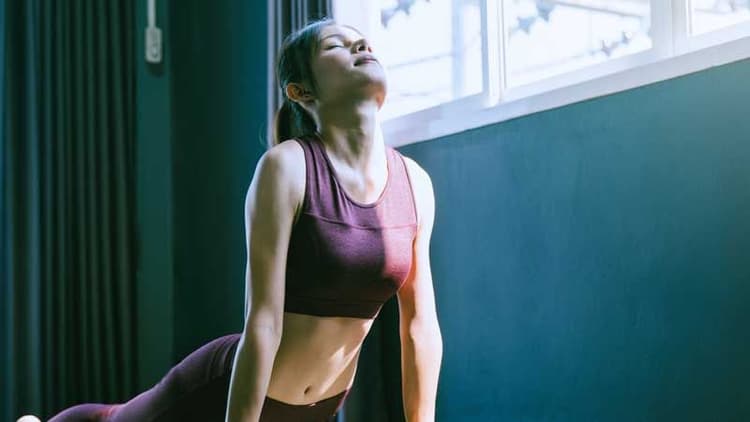
When people talk about yoga, the conversation usually revolves around flexibility, stress relief, better posture, or stronger muscles. We often picture familiar poses such as downward-facing dog, warrior pose, cobra, or child’s pose.
But what about the parts of your body that rarely get the spotlight?
Your ankles. Inner thighs. Feet. Deep core muscles. Hip stabilisers. The small muscles that help you balance and control movement.
One yoga pose that brings several of these areas into play is Malasana, also known as Garland Pose.
It looks simple. You lower into a deep squat, bring your hands together and hold the position. Yet underneath that simple appearance is a surprisingly demanding combination of mobility, balance, stability and muscular control.
Malasana is not a miracle exercise, nor does every person need to perform it deeply. But it can be an interesting addition to a well-rounded movement routine, especially when the goal is to give less-used movement patterns some attention.
Also Read - Healthy Aging Through Yoga: Build Strength, Improve Mobility, And Thrive
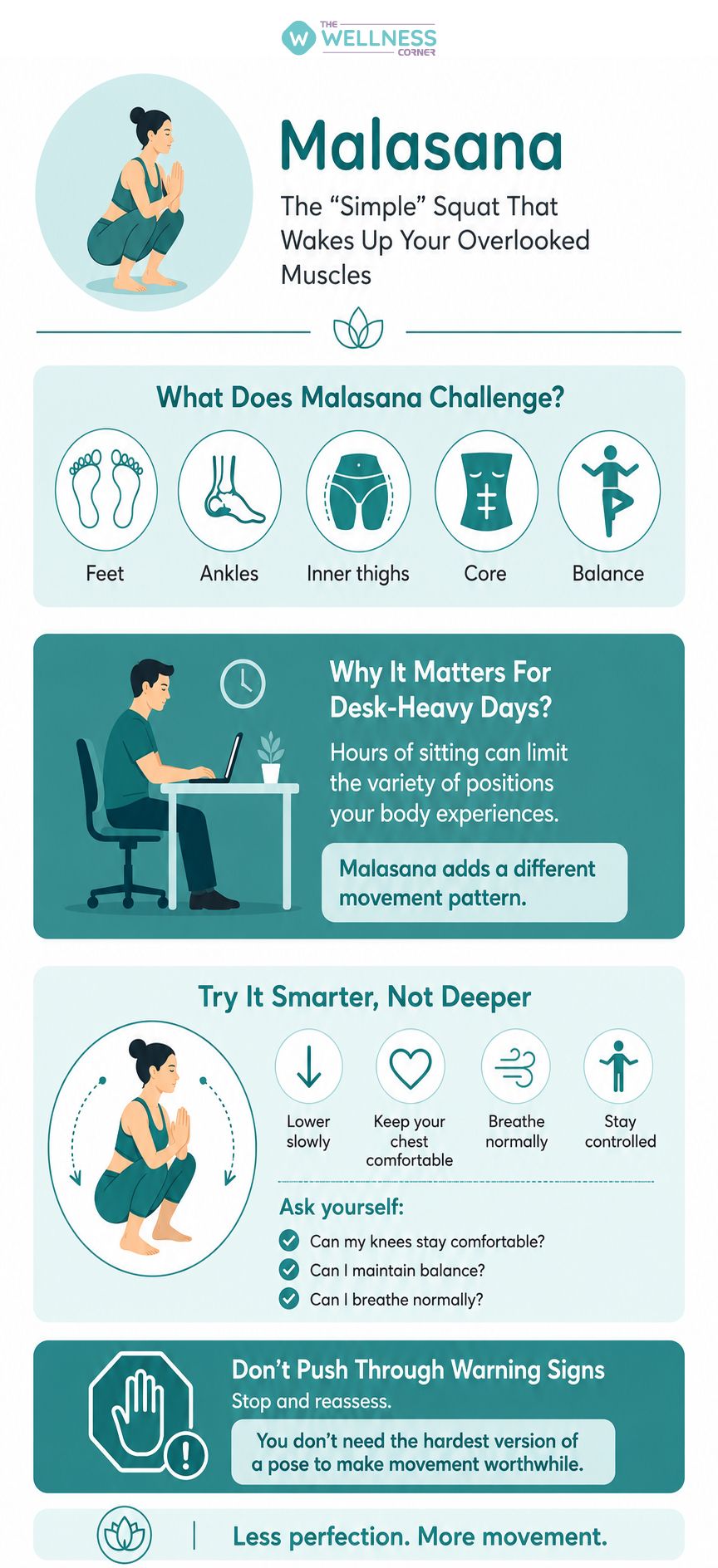
Meet The Deep Squat That Deserves More Attention
Malasana is essentially a yoga-based deep squat.
You stand with your feet apart, lower your hips toward the floor, bend your knees and keep your torso as upright as comfortably possible. Traditionally, the palms come together in front of the chest, while the elbows gently contact the inner knees.
The pose asks your body to coordinate several movements at once.
Your ankles need enough mobility to allow the knees to bend forward. Your hips move into a deep flexed position. Your legs and core help stabilise your body. Your feet act as the base that helps keep your body stable.
Research examining hip positions in yoga has found that several common yoga poses involve substantial hip movement, highlighting why individual mobility and comfort matter when performing deeper positions.
That is exactly why Malasana can feel surprisingly challenging, even when it does not look particularly athletic.
Your Ankles May Be The Real Limiting Factor
Most people associate flexibility with hamstrings and hips.
The ankles rarely receive the same attention.
Yet your ankle joints need to move adequately during everyday activities such as walking, climbing stairs and squatting. In Malasana, that mobility becomes particularly noticeable.
If your ankles are comfortable with the movement, you may be able to keep your heels grounded while lowering your hips. If ankle mobility is limited, you may notice your heels lifting or your balance becoming unstable.
That is useful information.
Do not try to press your heels into the floor forcefully. Instead, the pose can help you become more aware of how your ankles move and where your current mobility sits.
Also Read: A 15-Minute Intermediate Yoga Series For Strength And Flexibility

The Inner Thighs Finally Get A Mention
Your quadriceps and glutes get plenty of attention in many strength workouts.
Your inner thighs often do not.
The adductor muscles along the inner thigh contribute to controlling the position of your legs and pelvis. Malasana places your legs in a wide, bent position that requires those muscles to participate in stabilising the lower body.
That does not make Malasana a replacement for targeted strength training. It simply gives your inner thighs a different kind of challenge.
For someone who spends most of the day walking, sitting or exercising through repetitive movement patterns, that variation can be useful.
Your Core Is Working Without A Single Crunch
Core training does not always mean doing sit-ups.
Your abdominal and trunk muscles also help keep your torso stable when your lower body changes position.
In Malasana, maintaining an upright posture while your hips move downward requires control through your trunk. The challenge increases when you focus on staying tall rather than collapsing forward.
This is less about creating a dramatic abdominal burn and more about postural control.
That distinction matters.
A good movement routine should not only make muscles tired. It should also help you develop control over how your body moves.
Also Read: Strengthen Your Core to Manage Your Emotions And Gut-Brain Connection Effectively

Do Not Forget The Feet
Your feet are the foundation of the pose.
They connect your body to the floor and help distribute your weight as you balance in a deep squat.
Malasana can make you more aware of where you are placing pressure through your feet. Are you leaning heavily toward the heels? Are the toes gripping the floor? Are you placing more of your weight on one foot?
These small observations can improve body awareness.
The pose should not be viewed as a specialised treatment for foot problems. Instead, think of it as an opportunity to pay attention to a part of your body that is often taken for granted.
Balance Is Part Of The Challenge
Malasana also asks several systems to work together.
Your feet provide a base. Your ankles adjust. Your knees and hips maintain position. Your core keeps your torso stable.
That means the pose is not simply about how flexible you are.
It is also about coordination and balance.
This fits into a broader principle of physical fitness. The World Health Organization recommends regular physical activity and encourages adults to include muscle-strengthening activities involving major muscle groups on at least two days each week.
A varied movement routine can therefore be more useful than repeatedly training the same muscles in the same way.
Also Read: How Good Is Your Balancing Power? Take This 30-Second Test To Find Out

Why This Pose Feels Relevant In A Desk-Heavy Lifestyle?
Modern workdays often involve hours of sitting.
You may spend breakfast sitting, commute sitting, work at a desk, attend meetings in a chair, commute home and then relax on a sofa.
That does not mean sitting is automatically harmful or that Malasana can somehow "undo" a sedentary day.
The bigger lesson is about movement variety.
Your body experiences only a small selection of positions when your day revolves around a chair. Incorporating different movements can give your hips, ankles, legs and trunk opportunities to move in ways they may not encounter during a typical workday.
And sometimes, changing position is valuable simply because it is different.
How To Try Malasana Safely?
Start slowly.
Stand with your feet slightly wider than hip width and allow the toes to angle outward naturally. Bend your knees and lower your hips gradually.
Keep your chest lifted as much as is comfortable.
Bring your hands together in front of your chest if it helps with balance. Your elbows can rest gently against the inner knees.
Now pause.
Do not immediately try to get as low as possible.
Instead, notice how your body feels.
Can your heels stay supported? Are your knees comfortable? Can you breathe normally? Are you able to maintain control?
These questions matter more than how deep the squat looks.

Make The Pose Easier Instead Of Forcing It
Not everyone will perform Malasana in the same way.
Body proportions, mobility, previous injuries and general fitness can influence how the pose feels.
You can place a folded blanket underneath your heels if they do not comfortably reach the floor.
You can also sit onto a yoga block or another suitable stable support placed underneath the hips. Holding a sturdy support can help if balance is the main challenge.
These are not shortcuts.
They are modifications that allow you to work within your current ability.
Physical activity guidelines also recommend that people who are inactive start with smaller amounts and gradually increase duration, frequency and intensity.
The same principle makes sense here: progress does not need to happen all at once.
Also Read - Healthy Aging Through Yoga: Build Strength, Improve Mobility, And Thrive
What You Should Not Expect From Malasana?
Yoga poses sometimes receive extraordinary claims online.
Malasana cannot magically detox your body, reshape your internal organs or correct every posture or mobility problem.
It is also not a substitute for medical treatment, strength training or cardiovascular exercise.
Its value is much simpler.
It gives you a movement that combines lower-body mobility, balance, postural control and body awareness.
Sometimes that is more than enough reason to include a pose in your routine.
Know When To Modify Or Stop
A challenging stretch can feel uncomfortable without being painful.
However, sharp pain, significant joint discomfort, numbness, dizziness or a feeling that something is wrong should not be ignored.
People with existing knee, hip, ankle or lower-back problems may need individual guidance before attempting deep squat positions.
The fact that a pose is considered a traditional yoga posture does not mean that every variation is appropriate for every body.
Your anatomy matters.
Your current mobility matters.
Your previous injuries matter.
Listen to those signals instead of trying to copy an image of a perfect pose.
The Biggest Benefit May Be Better Body Awareness
Perhaps the most interesting thing about Malasana is not the muscles it works.
It is what the pose teaches you to notice.
You begin to recognise whether your ankles feel restricted. You become aware of how your knees track. You notice if your weight shifts unevenly. You feel whether your
hips are comfortable or tense.
That awareness can carry into other forms of movement.
A strong fitness routine is not simply about doing more repetitions or holding poses for longer. It is also about understanding how your body responds.
Add Variety Instead Of Chasing The Perfect Pose
You do not need to make Malasana the centre of your yoga practice.
Try it for a few controlled breaths during a mobility session or include it within a gentle yoga sequence.
Keep the movement comfortable.
Use support when necessary.
Focus on breathing, control and alignment rather than depth.
The World Health Organization emphasises that physical activity can be performed in many forms and that any activity is better than none, with gradual progression
encouraged for people who are less active.
That is a useful mindset for yoga too.
You do not need the hardest version of a pose to make movement worthwhile.
Explore More Ways To Support Your Wellbeing With The Wellness Corner
Yoga is just one part of a healthy lifestyle. Your everyday movement, nutrition, sleep, stress levels and mental wellbeing all contribute to how you feel.
For practical health and wellness resources covering fitness, nutrition, mental wellbeing and healthier lifestyle habits, explore The Wellness Corner and find simple ways to make wellbeing part of your everyday routine.
FAQs
Leave a Comment

Sign-Up Now & Unlock
₹100 Cashback
Recently Published
Related Articles


Health Checks @ Home
Service
Explore



Follow us on:


© 2026 Truworth Health Technologies Pvt. Ltd.