Which Mask Is Best For Pollution? N95 Vs Surgical Vs Cloth
1 day ago
9 minute read.
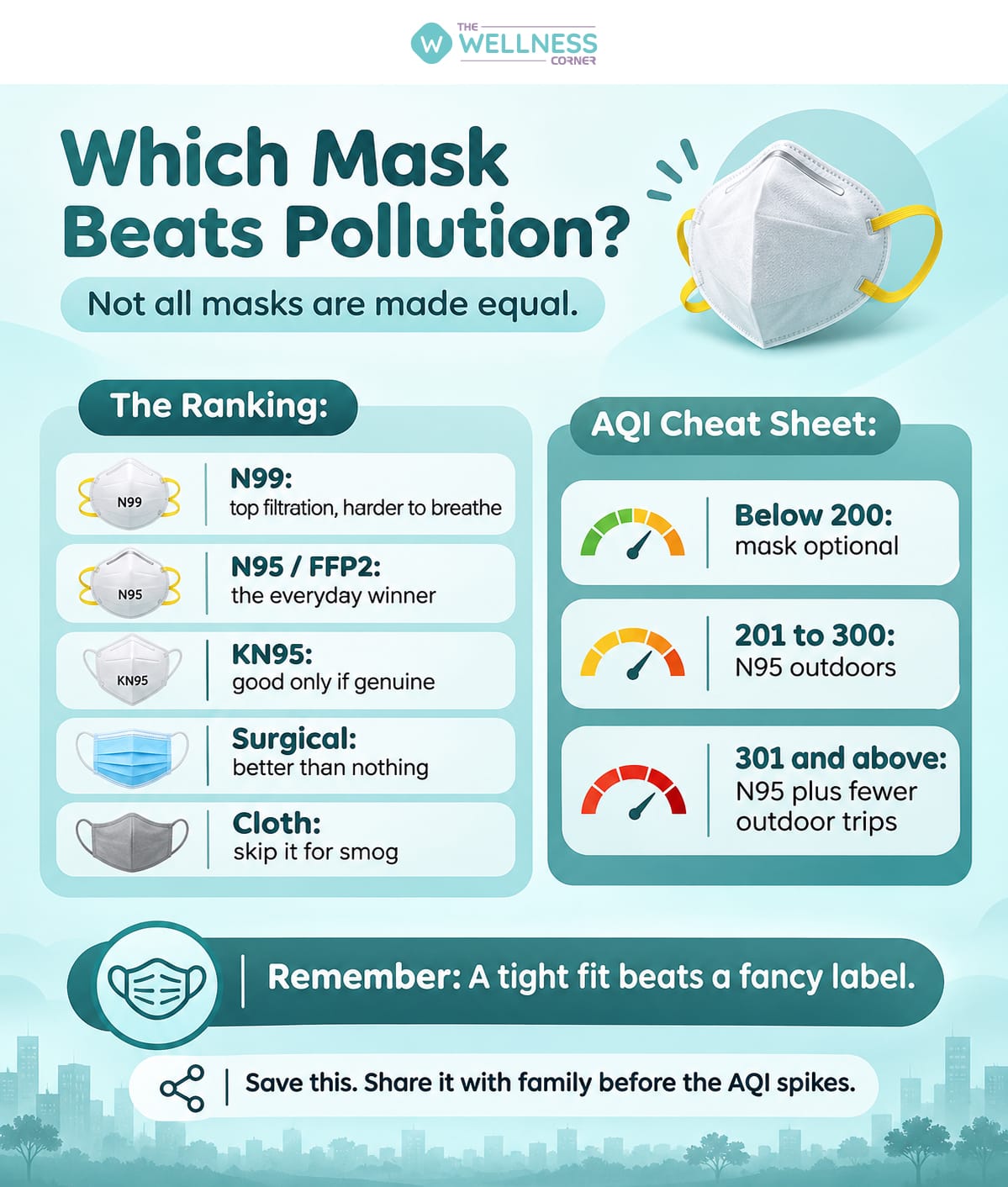
Short Answer (Blog Briefing)
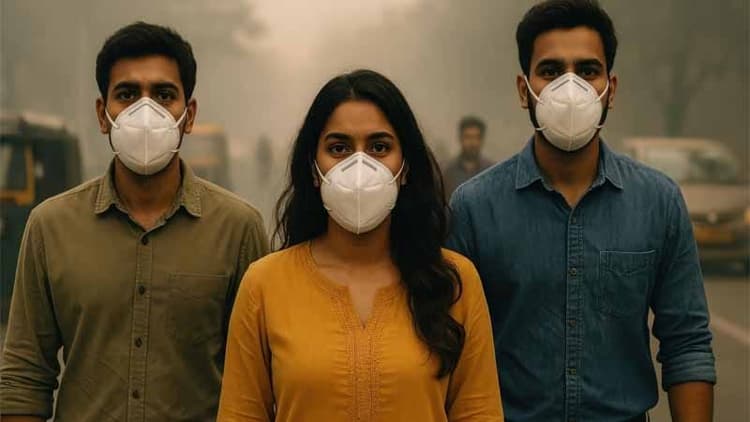
Every winter, and especially after Diwali, the air in many Indian cities turns thick with smog. AQI readings above 300 stop being a headline and become part of the daily commute. The obvious question follows: which mask is best for air pollution, and is the one in your drawer doing anything at all?
This guide compares N95, KN95, FFP2, N99, surgical and cloth masks, explains which mask to wear at which AQI level, and answers the questions people ask most, from reuse to asthma. If you want the short version of the best mask for pollution, it is a properly fitted N95. The rest of this article explains why, and when other options make sense.
Also Read: Protecting Lungs From Firework Smoke & AQI Spikes: Practical Guidelines For High-Risk Individuals
Do Masks Protect Against Air Pollution?
Yes, but only the right kind, worn the right way. The most harmful part of city air is PM2.5: particles smaller than 2.5 micrometres that travel deep into the lungs. Most masks were never designed to catch them.
A respirator such as an N95 forces the air you breathe in through a filter layer. The US CDC's NIOSH, the body that certifies N95s, explains that N95 and P100 respirators are designed to fit tightly to the face and filter particles as you inhale.
Two limits are worth knowing:
- Fit decides performance. A high-rated mask with gaps around the nose or cheeks lets unfiltered air in.
- Masks filter particles, not gases. Respirators do not protect against gases or vapours such as the nitrogen dioxide and ozone found in traffic pollution.
Mask Comparison at a Glance
|
Mask |
Filtration |
Fit |
Protection from PM2.5 |
Verdict |
|
N95 |
At least 95% of particles |
Tight, two head straps |
High |
Best everyday choice |
|
N99 |
At least 99% |
Tight, can be harder to breathe through |
Very high |
For severe smog or heavy exposure |
|
FFP2 (EU standard) |
At least 94% |
Tight |
High |
Good N95 equivalent |
|
KN95 (Chinese standard) |
95% claimed |
Often ear loops |
Variable |
Good only if genuine and well fitted |
|
Surgical mask |
Low for fine particles |
Loose |
Low |
Better than nothing, not for heavy smog |
|
Cloth mask |
Low |
Loose |
Very low |
Not recommended for pollution |
N95 Mask for Pollution
An N95 is the standard answer to the best mask for pollution question. The "95" means it filters at least 95% of tiny test particles, and genuine ones carry NIOSH certification markings. Two head straps, a moulded shape and a nose clip help it seal.
Choose an N95 if you commute by two-wheeler or bus, spend time near traffic, or live in a city where AQI often crosses 200. Models with an exhalation valve are fine for pollution because the valve only releases your breath. They are not suitable when you need to protect others from your own breath, for example while sick.
N95 vs KN95 vs FFP2: Which Is Better?
All three are filtering respirators made to different national standards:
- N95: US standard, certified by NIOSH.
- FFP2: European standard, at least 94% filtration.
- KN95: Chinese standard, 95% filtration.
In theory they perform similarly. In practice, the difference is quality control. KN95s are not NIOSH certified, and US CDC testing found that many KN95 products did not meet their advertised filtration. If you have to choose between an N95 and a KN95, take the N95 from a trusted seller. A genuine KN95 or FFP2 that fits well is a reasonable alternative when an N95 is unavailable.
Red flags for fakes: missing or misspelt certification markings, no standard printed on the mask, ear loops on a mask sold as an N95, and unusually cheap multipacks from unknown sellers.
N99 Mask for Pollution
An N99 filters at least 99% of particles. It gives extra filtration, which can help during severe smog or if you are outdoors for long periods. The trade-off is that it can feel harder to breathe through, which matters for people with lung conditions. For most people, a well-fitted N95 gives the best balance of protection and comfort.
Surgical Mask for Pollution
Surgical masks are designed to stop droplets leaving the wearer, not to filter fine particles in. They fit loosely, so air flows around the edges. Public health agencies advise against relying on them for smoke or fine particulate pollution.
Use a surgical mask if nothing better is available, or for short, low-exposure errands when the AQI is moderate. It is better than going bare-faced, but it is not the best mask for pollution when AQI is in the poor or very poor range.
Cloth Mask for Pollution
Do cloth masks protect against pollution? Very little. Fabric weaves have large gaps compared with PM2.5 particles, and most cloth masks leak at the edges. US health guidance is explicit that cloth masks, bandanas, scarves and tissues will not filter out smoke or fine particles. A dupatta or handkerchief gives no meaningful protection from PM2.5.
Cloth masks can still keep out larger dust on a dry day, but they should not be your plan when AQI is high.
Which Mask to Wear When AQI Is Above 300?
India's Central Pollution Control Board (CPCB) classifies AQI 201 to 300 as "poor", 301 to 400 as "very poor" and 401 to 500 as "severe". At very poor levels, prolonged exposure may cause respiratory illness, and effects are stronger for people with lung or heart disease. At severe levels, even healthy people can be affected.
The CPCB does not prescribe specific masks for each category, so treat this as practical guidance based on how respirators work:
|
AQI range (CPCB) |
Category |
Practical mask advice |
|
0 to 100 |
Good to satisfactory |
No mask needed for most people |
|
101 to 200 |
Moderate |
Sensitive groups may wear an N95 on busy roads |
|
201 to 300 |
Poor |
N95 recommended outdoors, especially in traffic |
|
301 to 400 |
Very poor |
N95 (or better) for everyone outdoors, limit time outside |
|
401 to 500 |
Severe |
N95 or N99, avoid outdoor exertion, stay indoors where
possible |
If your AQI is above 300, the answer to which mask to wear is a well-fitted N95, plus fewer and shorter trips outside.
Best Mask for Diwali Pollution
Firecracker smoke and winter weather trap fine particles near the ground in the days after Diwali. For the best mask for Diwali pollution, use a fitted N95, buy before the festival rather than during the rush, and keep a few spares. A mask will not protect you from sparks or strong fumes, and it does not replace staying a safe distance from fireworks.
Also Read - Safe Diwali, Happy Diwali: Celebrate Mindfully And Meaningfully!!
Best Anti-Pollution Mask for Daily Commute
For a daily commute, look for:
- Certified filtration: an N95, FFP2 or genuine KN95 marking.
- Head straps and nose clip: these seal better than ear loops, especially under a helmet.
- Comfort: a shape and size that you can wear for 30 to 60 minutes without constant adjusting.
- An optional exhalation valve: it can reduce heat and moisture build-up in warm weather.
Two-wheeler riders are exposed to the most traffic fumes, so check that your helmet and mask work together and the seal does not break when you turn your head.
Best Mask for Pollution for People With Asthma
People with asthma, COPD or heart disease are more sensitive to polluted air, so protection matters more, but so does comfort. A respirator makes breathing slightly harder, and for some people with lung disease that effort is noticeable.
- Talk to your doctor before wearing an N95 every day, and ask whether your treatment plan needs changing during high-AQI periods.
- Try the mask while resting at home first. If you feel breathless, dizzy or tight in the chest, take it off and move to cleaner air.
- Keep reliever medication with you.
- Cut down outdoor exertion on poor air days, since a mask does not make strenuous exercise outdoors safe.
How to Wear an N95 Properly?
- Wash your hands and check the mask for damage.
- Place it over your nose and under your chin, with one strap above your ears and one below.
- Press the nose clip to the shape of your nose.
- Do a seal check: breathe in and out gently and feel for air leaking at the edges.
- Adjust and repeat until there are no leaks.
Facial hair along the seal line prevents a good fit, and most adult N95s do not fit young children well.
How Many Times Can You Reuse an N95 for Pollution?
There is no official reuse count for everyday pollution. Safety guidance says to replace the mask when it is dirty, wet, damaged, or when breathing through it gets harder. For short outings in moderate air, many people use the same mask for several trips. In heavy smog, replace it sooner, often after a day of use outdoors.
To make a mask last: store it dry in a paper bag between uses, avoid crushing it, and do not wash it, since washing damages the filter material.
Beyond Masks: Other Ways to Cut Your Pollution Exposure
- Check your local AQI daily and plan errands for cleaner hours.
- Keep windows closed during peak pollution and use an air purifier with a HEPA filter indoors.
- Move workouts indoors on very poor or severe days.
- Avoid idling near heavy traffic or burning waste.
Final Thoughts
The best mask for pollution is the one that is certified, fits your face and that you will actually wear. For most people in Indian cities, that means a genuine N95, backed up by checking the AQI, limiting time outdoors and cleaning the air at home. Surgical and cloth masks are not enough once air quality turns poor, and nobody should assume a mask makes heavy smog safe. If you have asthma or another condition, talk to your doctor before making a daily habit of it.
Coughing, wheezing or breathless this smog season? Don't wait it out. Talk to a doctor on The Wellness Corner app and get advice on managing breathing problems and protecting your lungs.
Sources And Further Reading
- CDC NIOSH: Protecting workers and the public from wildfire smoke (respirator selection and fit)
- US EPA: Protect yourself from wildfire smoke and ash
- Central Pollution Control Board: National Air Quality Index
Disclaimer: This article is for general information and is not medical advice. If you have asthma, heart disease or any breathing problem, please consult a doctor before using a respirator regularly.
Frequently Asked Questions About the Best Mask for Pollution
Leave a Comment

Sign-Up Now & Unlock
₹100 Cashback
Subscribe to our Newsletter!
Get a weekly dose of wellness tips delivered straight to your inbox.
Recently Published
Related Articles


Health Checks @ Home
Service
Explore



Follow us on:


© 2026 Truworth Health Technologies Pvt. Ltd.