Why Do Meetings Leave You More Drained Than Real Work?
1 month ago
6 minute read.

Have you ever finished a day packed with meetings only to realize you've barely completed any actual work? By the end of the day, you may feel mentally drained despite spending most of your time sitting in front of a screen or around a conference table.
If this sounds familiar, you're not alone. Many professionals experience what's often called "meeting fatigue" - the feeling of being mentally exhausted after attending multiple discussions, video calls, or lengthy presentations. While meetings are an essential part of collaboration, too many of them can leave employees feeling overwhelmed, reduce productivity, and make it harder to focus on meaningful work.
The good news is that this exhaustion isn't simply "in your head." Research in psychology and workplace behavior suggests there are several reasons why meetings can consume more mental energy than many hands-on tasks.
Let's explore why meetings often feel more tiring than actual work and what you can do to reduce their impact on your productivity and well-being.
Also Read - Post-Meeting Exhaustion: Why 30 Minutes Feels Like A Mental Marathon?
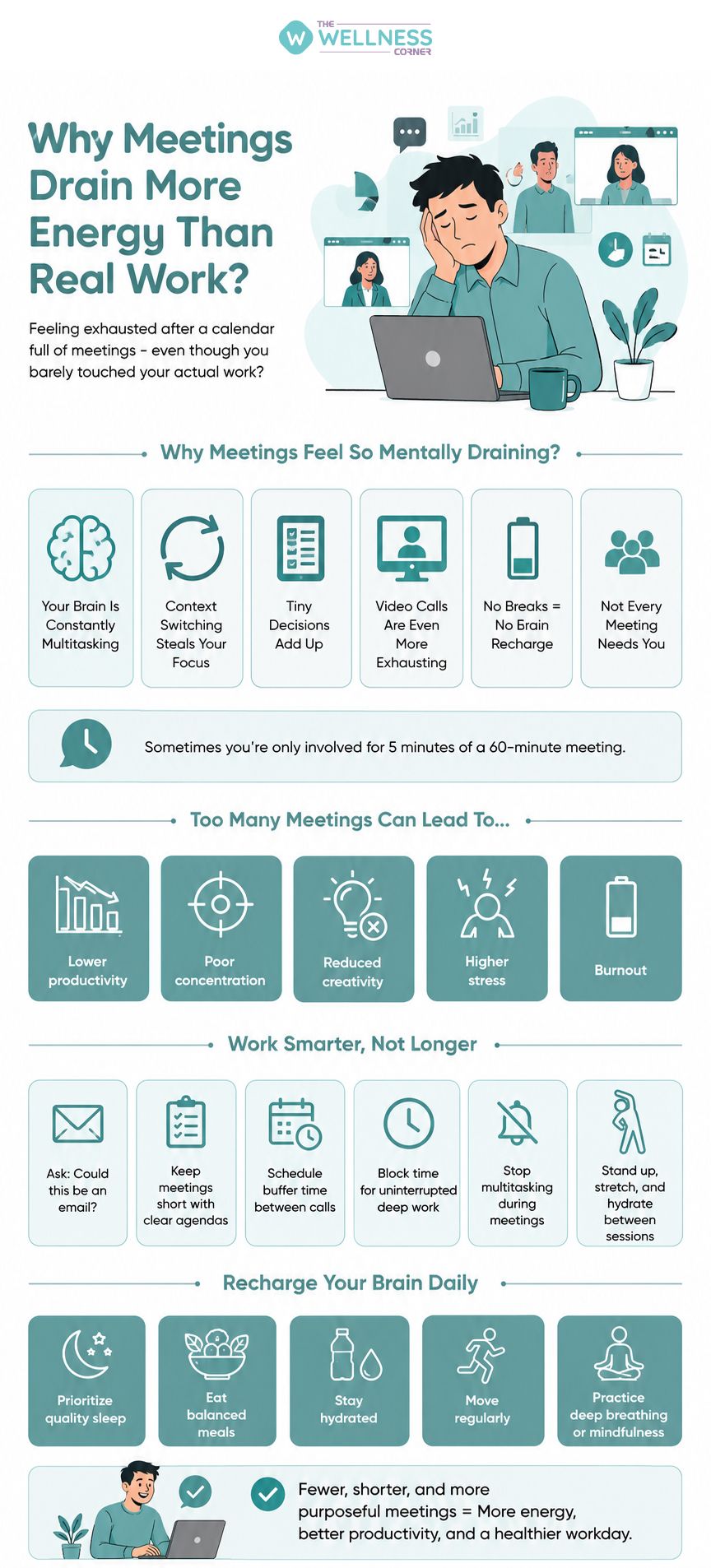
The Hidden Mental Load Of Meetings
At first glance, meetings may seem less demanding than completing reports, solving problems, or managing projects. In reality, your brain is usually doing far more work than it appears to during meetings.
During a meeting, you're expected to:
- Listen carefully
- Process new information
- Interpret verbal and non-verbal cues
- Take notes
- Respond thoughtfully
- Remember action items
- Avoid distractions
- Think about upcoming tasks
Unlike focused work, where attention is directed toward a single objective, meetings often require constant switching between listening, thinking, speaking, and planning. This continuous mental juggling increases cognitive load and contributes to fatigue.
1. Your Brain Rarely Gets A Chance To Focus
Deep work allows your brain to concentrate on one meaningful task without interruption. Meetings interrupt that flow.
Every time you shift from focused work to a meeting and then back again, your brain needs time to regain concentration. This process, often called context switching, reduces mental efficiency and increases fatigue throughout the day.
Even short meetings can disrupt momentum, making it harder to return to complex tasks afterward.
Also Read: 5 Minute Brain Workout To Sharpen Your Mind & Boost Focus

2. Decision Fatigue Builds Throughout The Day
Meetings often involve dozens of small decisions.
Should you speak now?
Do you agree with the proposal?
Which task should take priority?
How should you respond?
Although each decision may seem minor, together they gradually consume mental energy.
By the afternoon, decision fatigue can make even simple tasks feel more difficult than they actually are.
3. Video Meetings Demand Even More Mental Energy
Virtual meetings have become a regular part of modern work, but they introduce additional challenges.
During video calls, your brain must process:
- Multiple faces on screen
- Slight audio delays
- Limited body language
- Continuous self-awareness from seeing your own image
- Fewer natural conversational cues
This extra mental processing explains why several hours of virtual meetings can feel surprisingly exhausting.
Also Read - Why Online Conversations Are Often Misleading: Understanding Digital Body Language Misinterpretations

4. Long Meetings Leave Little Room For Recovery
Your brain performs best when periods of focused effort are balanced with short breaks.
Back-to-back meetings leave little opportunity to:
- Stretch
- Walk around
- Hydrate
- Rest your eyes
- Reflect on discussions
Without these recovery moments, mental fatigue accumulates quickly.
Even a five-minute break between meetings can help improve focus and reduce stress.
5. Not Every Meeting Requires Your Full Attention
Many professionals attend meetings where only a small portion of the discussion is directly relevant to their work.
Remaining attentive while waiting for your agenda item requires sustained concentration without continuous engagement.
This passive attention can be surprisingly tiring because your brain stays alert while receiving relatively little meaningful stimulation.
6. Multitasking Makes Fatigue Worse
It may seem productive to answer emails, reply to messages, or work on documents during meetings.
In reality, multitasking forces your brain to switch rapidly between tasks instead of performing them simultaneously.
This constant switching increases mental effort, reduces information retention, and often leaves you feeling even more exhausted.
Also Read: 10 Reasons Why You Should Stop Multitasking

The Cost Of Too Many Meetings
Meeting overload doesn't just affect energy levels. It can also influence overall workplace performance.
Excessive meetings may contribute to:
- Reduced productivity
- Lower creativity
- Increased stress
- Difficulty concentrating
- Delayed project completion
- Employee burnout
- Lower job satisfaction
Organizations are increasingly recognizing that meeting quality often matters far more than meeting quantity.
How To Make Meetings Less Draining?
Fortunately, a few simple strategies can make meetings more productive and less exhausting.
1. Schedule Meetings Only When Necessary
Before arranging a meeting, consider whether the information could be shared through an email, document, or chat message instead.
Not every discussion requires everyone to gather at the same time.

2. Keep Meetings Focused
Having a clear agenda helps participants prepare and keeps conversations on track.
Define:
- The purpose
- Expected outcomes
- Time limits
- Action items
Shorter, well-structured meetings often produce better results.
3. Build Breaks Into Your Schedule
Avoid scheduling meetings back-to-back whenever possible.
Even brief breaks can help you:
- Stand up and stretch
- Drink water
- Rest your eyes
- Reset your focus
These small pauses allow your brain to recover before the next task.
Also Read: How To Take Breaks To Get More Done?
4. Protect Time For Deep Work
Set aside uninterrupted periods in your calendar for focused work.
This gives your brain the opportunity to complete complex tasks without constant interruptions.
Many organizations now encourage "meeting-free" blocks or even meeting-free days to support productivity.

5. Limit Multitasking
Although it may seem efficient, trying to do several things during a meeting usually increases mental strain.
Whenever you can, give the discussion your full attention and tackle other tasks once the meeting is over.
Supporting Your Mental Energy Throughout The Workday
Beyond improving meeting habits, several lifestyle practices can help you maintain mental performance throughout the day.
These include:
- Getting enough quality sleep
- Staying physically active
- Drinking enough water
- Eating balanced meals
- Taking regular movement breaks
- Practicing mindfulness or deep breathing
- Setting realistic boundaries around your workload
Supporting your overall well-being can improve focus, resilience, and productivity both inside and outside meetings.
The Bottom Line
Meetings are an important part of teamwork, communication, and decision-making, but they also demand significant mental effort. Constant context switching, decision-making, prolonged attention, and limited recovery time can all contribute to meeting fatigue.
Rather than eliminating meetings altogether, the goal should be to make them more purposeful, efficient, and balanced with uninterrupted time for meaningful work.
Small changes, such as shortening meetings, scheduling breaks, and protecting time for focused tasks, can help reduce mental exhaustion while improving both productivity and workplace well-being.

Frequently Asked Questions
Leave a Comment

Sign-Up Now & Unlock
₹100 Cashback
Recently Published
Related Articles


Health Checks @ Home
Service
Explore



Follow us on:


© 2026 Truworth Health Technologies Pvt. Ltd.