Overthinking Every Small Decision? Here's Why Your Brain Does This
14 hours ago
6 minute read.

Overthinking small decisions often happens when your brain tries to avoid mistakes, uncertainty, regret, or criticism. Stress, perfectionism, fear of making the wrong decision, and mental exhaustion can make even simple choices feel complicated. Learning how to stop overthinking involves setting decision limits, accepting that uncertainty is normal, and focusing on what matters rather than trying to find a perfect answer.
Also Read: 5 Quick And Effective Ways To Deal With Overthinking
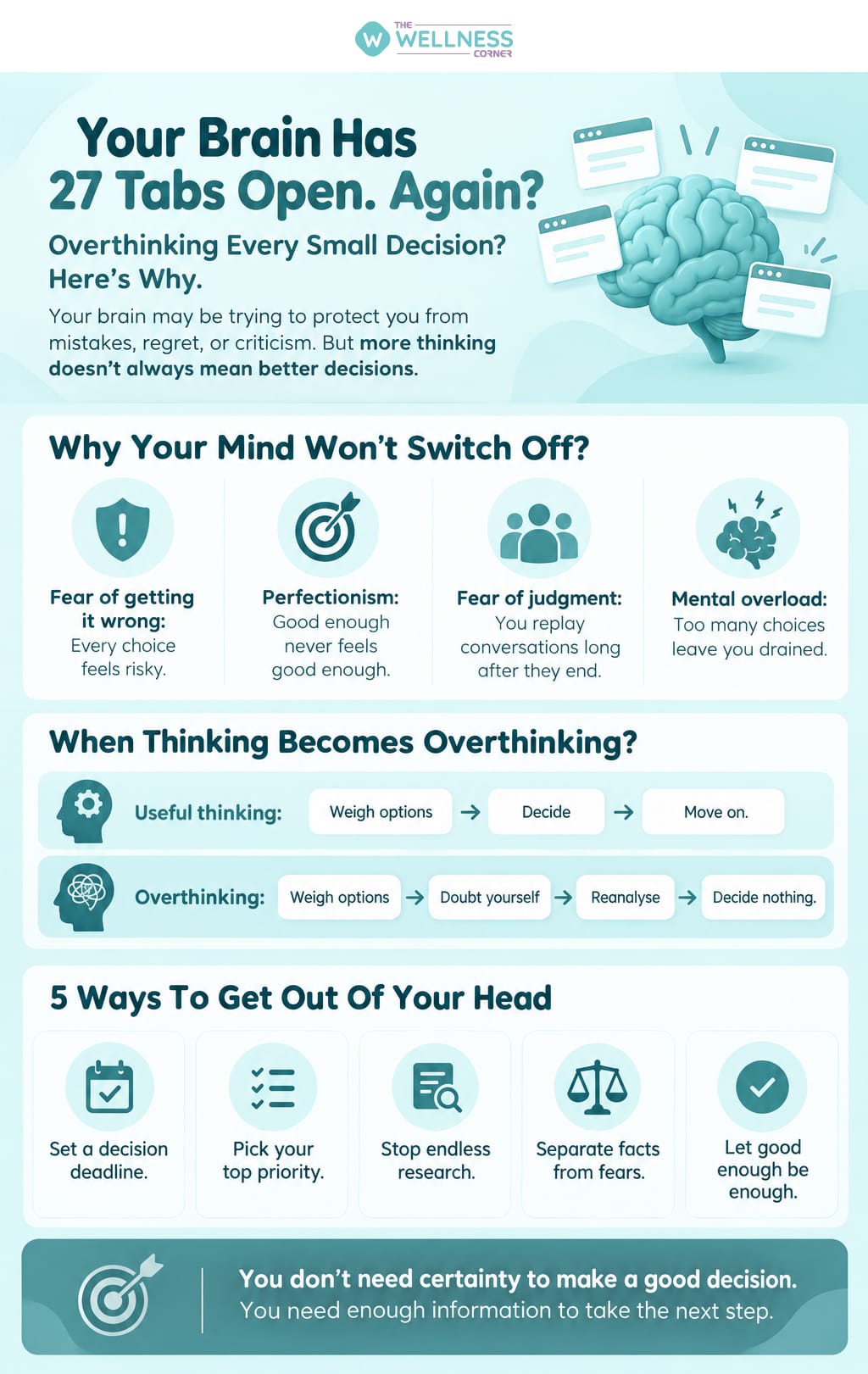
1. Why Do You Overthink Every Little Thing?
Should you reply to that message now or later? Was your comment in the meeting awkward? Should you order your usual coffee or try something new? If these ordinary decisions trigger a lengthy internal debate, you may wonder, why do I overthink small decisions?
Overthinking often develops when your mind tries to predict every possible outcome before allowing you to act. You may replay conversations, imagine worst-case scenarios, or search for reassurance that you are making the right choice.
Several causes of overthinking can contribute to this pattern, including perfectionism, past mistakes, fear of criticism, low confidence, and stressful experiences.
Sometimes, the more you care about getting something right, the harder it becomes to choose.
The first step in learning how to stop overthinking is recognising that the problem is not necessarily your ability to make decisions. It may be your expectation that every decision must be completely risk-free.
2. What Happens In Your Brain When You Overthink?
Your brain is designed to assess risks, learn from experiences, and anticipate what might happen next. These abilities help you solve problems, but they can become exhausting when every possibility receives equal attention.
For example, choosing a new phone may involve comparing features, prices, reviews, and warranties. That is useful research. But if you continue comparing nearly identical options long after you have enough information, the process may stop helping you.
Overthinking can also create a loop: you feel uncertain, analyse the situation, discover more possibilities, and become even less certain. Repeatedly seeking reassurance may provide temporary relief without building confidence in your own judgement.
Understanding this pattern can help you learn how to train your brain to stop overthinking. Instead of trying to eliminate every doubt, practise noticing uncertainty without treating it as a problem that must be solved immediately.
Also Read: 5 Minute Brain Workout To Sharpen Your Mind & Boost Focus
3. Decision Paralysis: When Thinking Gets In The Way?
Have you ever spent so long weighing your options that you ended up choosing nothing? This is often described as decision paralysis or analysis paralysis.
It can happen when you have too many choices, too much information, or unrealistic expectations about the outcome. A simple decision starts feeling like a test of your intelligence, competence, or future happiness.
Fear of making the wrong decision can make the situation feel even more overwhelming. You may delay responding to an email, choosing a course, making a purchase, or starting a project because you want greater certainty.
Limit yourself to two or three practical alternatives to avoid getting stuck in endless comparisons. Decide which factors matter most, give yourself a time limit, and choose based on the information you currently have. Remember, many everyday decisions are adjustable rather than permanent.

4. Decision Fatigue Symptoms You Should Recognise
Your ability to make choices can feel weaker after a demanding day filled with meetings, responsibilities, interruptions, and constant decisions. This experience is commonly called decision fatigue.
Possible decision fatigue symptoms include irritability, difficulty concentrating, delaying simple choices, feeling mentally drained, or relying on familiar options because comparing alternatives feels exhausting.
When you are mentally tired, deciding what to eat or which task to tackle first may suddenly seem harder than usual. This does not automatically mean you have a mental health condition. It may simply signal that you need a break.
If you want to understand how to stop overthinking, reduce unnecessary choices where possible. Decide on meals ahead of time, organise the items you need for work, and build easy-to-follow patterns for regular activities. Save your attention for decisions that genuinely require it.
Also Read: Mindfulness & Concentration
5. How To Stop Overthinking And Make Decisions Faster?
Learning how to stop overthinking every decision does not mean becoming careless. It means knowing when enough thinking is enough.
Try these practical strategies:
- Set a decision deadline: Give small choices a minute or two, and allow more time for important decisions.
- Define your priorities: Identify what matters most before comparing options, such as cost, convenience, quality, or time.
- Limit information gathering: Research until you have enough reliable information to choose, rather than searching endlessly for reassurance.
- Accept good enough: The best available option does not need to be perfect to be useful.
- Separate facts from fears: Ask yourself what you know for certain and what you are only imagining.
- Practise choosing: Make low-stakes decisions without repeatedly revisiting them.
These habits can help you learn how to make decisions faster while building confidence in your judgement. They are also practical ways to understand how to stop second guessing yourself.
When you catch yourself reopening a settled decision, remind yourself why you made it. Reconsider only when new information appears, not simply because discomfort returns.
6. How To Stop Overthinking At Night?
Night-time can make overthinking feel louder. In the absence of distractions, your mind may dwell on outstanding work, challenging conversations, and obligations you still need to handle.
If you are exploring how to stop overthinking at night, try creating a short wind-down routine. Jot down outstanding tasks and outline what you need to do next for each. This helps move reminders out of your head and onto paper.
You can also reduce stimulating screen use before bed, practise slow breathing, or listen to something calming. If a worry appears, acknowledge it without forcing yourself to solve it immediately.
The goal isn't to eliminate every thought, but to recognise that not all of them require immediate action. If persistent worry regularly disrupts your sleep, consider speaking with a qualified mental health professional.
Also Read: Breathing Exercises To Keep Your Lungs Healthy During Winter
7. Overthinking Vs Anxiety: What's The Difference?
Overthinking describes a pattern of repetitive thinking. Anxiety involves worry, fear, or apprehension that may also produce physical symptoms such as restlessness, muscle tension, or a racing heart.
Understanding the overthinking vs anxiety difference can be helpful, but the two can overlap. Overthinking may occur during stressful periods without indicating an anxiety disorder. However, persistent worry that interferes with sleep, relationships, work, or daily activities deserves attention.
Learning how to stop overthinking can help manage repetitive thought patterns, but it is not a substitute for professional support when distress becomes difficult to manage. A mental health professional can help you understand what is happening and identify suitable coping strategies.

Give Your Mind Permission To Move Forward
You do not need to analyse every possibility to make a good decision. Sometimes, progress begins when you accept that uncertainty is part of life and trust yourself to respond if things do not go as planned.
Start small: set a time limit for everyday choices, focus on what you can control, and allow yourself to move on once a decision is made. With practice, how to stop overthinking becomes less about controlling every thought and more about changing how you respond to it.
Explore The Wellness Corner for practical health and wellness resources that support your mental well-being, everyday habits, and a healthier relationship with stress.
If overthinking consistently affects your daily life, consider seeking guidance from a qualified mental health professional.
Also Read: Stress Management Tips
Frequently Asked Questions
> Disclaimer: This article is intended for general educational and informational purposes only and should not replace professional mental health care, diagnosis, or treatment. Mindfulness and relaxation practices may affect individuals differently. If you are experiencing persistent emotional or psychological difficulties or they are affecting your daily life, consider speaking with a qualified mental health professional.
Leave a Comment

Sign-Up Now & Unlock
₹100 Cashback
Subscribe to our Newsletter!
Get a weekly dose of wellness tips delivered straight to your inbox.
Recently Published
Related Articles


Health Checks @ Home
Service
Explore



Follow us on:


© 2026 Truworth Health Technologies Pvt. Ltd.