Things You Should Never Say To Someone With ADHD
11 hours ago
6 minute read.

Living with ADHD can mean navigating challenges that are often invisible to everyone else. A person may struggle to stay focused during a conversation, remember an appointment, manage time, control impulses, or complete tasks that seem simple from the outside. These difficulties are not necessarily a reflection of their intelligence, effort, or character.
That is why the words we use around someone with ADHD matter. A casual comment intended as advice can sometimes sound dismissive, judgmental, or hurtful. Understanding what not to say can make conversations more supportive and help create an environment where the person feels understood rather than criticized.
If you work with, live with, or care about someone with ADHD, a little awareness can make a meaningful difference.
Also Read: How Doodling Helps Kids With ADHD To Focus?
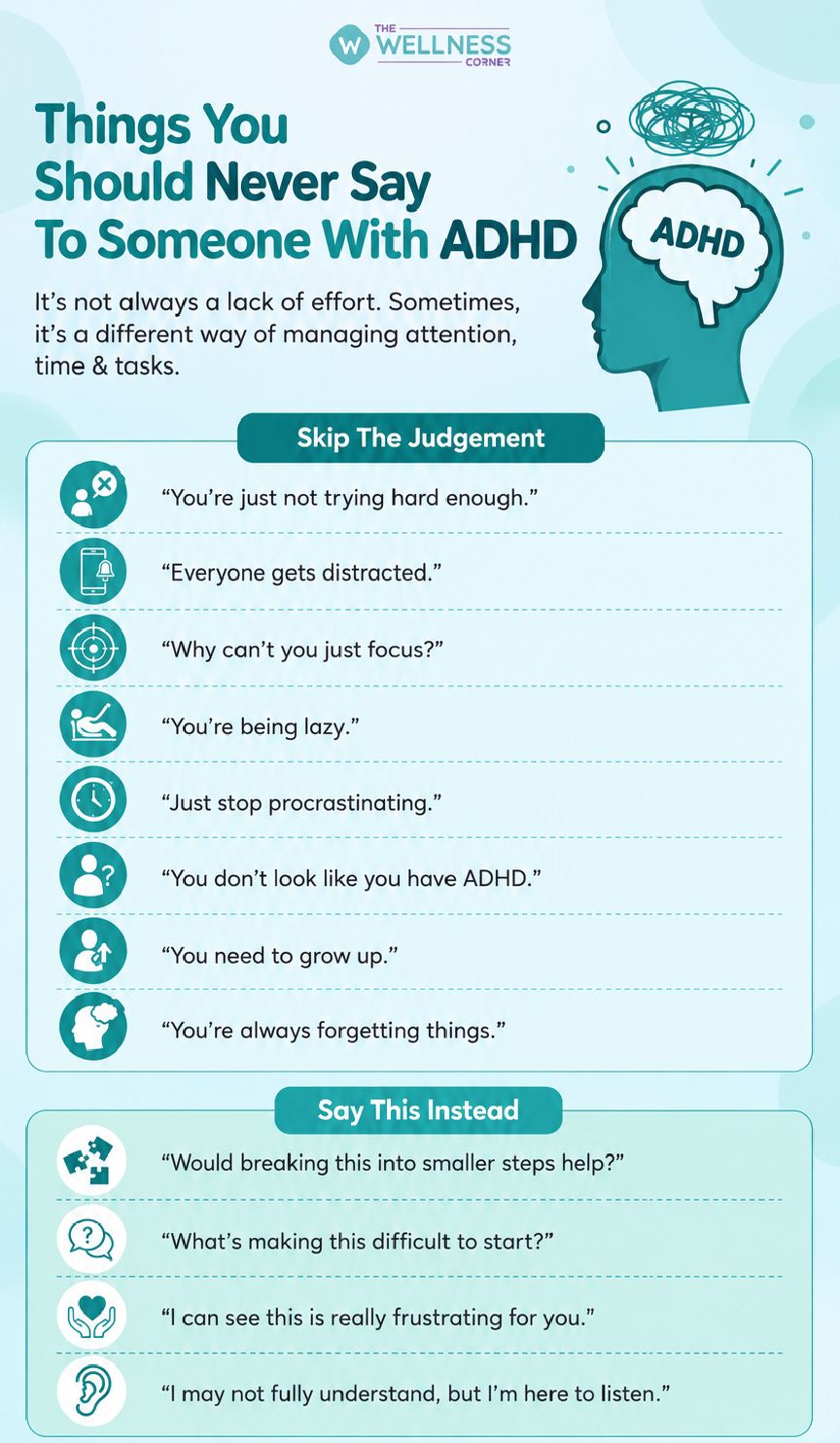
"You're Just Not Trying Hard Enough"
This may be one of the most frustrating things someone with ADHD can hear.
ADHD can affect executive functions such as attention regulation, organization, working memory, and impulse control. A person may genuinely want to complete a task and still find it difficult to begin, organize, or finish it.
Telling them they are not trying can turn a genuine challenge into a perceived character flaw.
Instead, ask what is making the task difficult and whether there is a practical way to make it more manageable.
"Everyone Gets Distracted Sometimes"
Everyone experiences occasional distraction, but ADHD is more than simply losing focus from time to time.
For someone with ADHD, difficulties with attention and executive functioning can be persistent and can affect work, relationships, studies, and everyday responsibilities.
Comparing their experience with your occasional distraction can unintentionally minimize what they are dealing with.
You do not need to completely understand their experience to acknowledge that it is real.
Also Read: Do You Get Distracted Easily? What Helps Tame A Wandering Mind?

"You Need To Be More Organized"
Organization may look easy from the outside. Make a list, set a reminder, clean your desk, and get things done. For someone with ADHD, however, organizing several tasks and deciding where to begin can itself become overwhelming.
Instead of simply telling someone to "get organized," offer practical support if they want it. Breaking a large task into smaller steps, using reminders, or establishing a predictable routine may be more useful than criticism.
"Why Can't You Just Focus?"
This question assumes that concentration is something a person can switch on whenever necessary.
Having ADHD does not mean a person is unable to concentrate. In fact, some people with ADHD can become intensely absorbed in activities that are particularly interesting or stimulating to them.
The challenge can be regulating attention consistently, particularly when a task feels repetitive, overwhelming, or uninteresting.
Try asking, “Would it be easier if we tackled this one part at a time?”

"You're Always Forgetting Things"
Forgetfulness can be a genuine challenge for some people with ADHD. They may forget appointments, misplace objects, overlook messages, or lose track of instructions.
Repeatedly pointing this out may increase embarrassment without solving the underlying problem.
Instead, encourage systems that reduce reliance on memory. Calendar reminders, written instructions, alarms, and designated places for frequently used items can make everyday tasks easier.
"You're Being Lazy"
This statement can be particularly damaging because it turns a difficulty into a judgment about someone's character.
A person who appears to be procrastinating may actually be struggling with task initiation, overwhelm, time perception, or maintaining attention.
What looks like laziness from the outside may involve a much more complicated process internally.
Before making assumptions, consider asking what is getting in the way.
Also Read: How Short Videos Are Rewiring Your Attention Span?

"You Don't Look Like You Have ADHD"
ADHD does not have one particular appearance.
Someone can be successful, organized in certain areas, socially confident, or highly accomplished and still experience significant ADHD-related challenges.
People also develop strategies to compensate for difficulties that others may never notice. Assuming someone cannot have ADHD because they seem "too organized" or "too capable" can invalidate their experience.
"Just Stop Procrastinating"
For many people, procrastination is not simply a matter of choosing not to work.
Starting a task can be particularly difficult when it feels overwhelming, lacks immediate stimulation, or requires several steps to complete. This can create a frustrating cycle where delaying the task increases stress, which makes starting even harder.
Rather than focusing on the delay itself, help identify what would make starting easier. A five-minute starting point, a clear deadline, or dividing the task into smaller actions may help.
Also Read: How To Stop Procrastinating?

"You're Overreacting"
People with ADHD can experience emotions intensely, and some may struggle with emotional regulation. Telling someone that they are overreacting dismisses what they are feeling without addressing the reason behind it.
You do not have to agree with someone's reaction to acknowledge their emotions.
Try listening first. A simple "I can see that this is really frustrating for you" can create space for a calmer and more constructive conversation.
"You Need To Grow Up"
ADHD is not a sign of immaturity.
Adults with ADHD can have responsibilities, careers, relationships, families, and successful lives while still experiencing difficulties associated with the condition.
Using age or maturity as a criticism can create shame rather than encourage positive change.
If a particular behavior is causing a problem, discuss the behavior itself instead of attacking the person's character.

"I Know Exactly How You Feel"
Even when you are trying to be supportive, claiming to completely understand another person's experience can unintentionally shift the focus away from them.
You might have experienced distraction, forgetfulness, or difficulty concentrating, but that does not necessarily mean your experience is the same.
Instead, try saying, "I may not fully understand what you're experiencing, but I'm here to listen."
What Should You Say Instead?
Support does not require having perfect words. Sometimes, the simplest approach is the most helpful.
You can say:
- "How can I support you?"
- "Would you like help breaking this down?"
- "Take your time."
- "Let's figure out what might work for you."
- "I understand that this is difficult."
- "Would a reminder be helpful?"
The goal is not to treat the person differently because they have ADHD. It is to communicate without unnecessary judgment and recognize that everyone has different needs.

Build Understanding Instead Of Judgment
ADHD can affect different people in different ways. Some may struggle primarily with attention, while others may experience difficulties with impulsivity, organization, time management, or emotional regulation. The challenges can also vary throughout different stages of life.
The most helpful response is therefore not to make assumptions. Listen, ask questions, and focus on practical solutions when support is wanted.
Most importantly, remember that a diagnosis does not define a person's intelligence, potential, personality, or worth.

The Bottom Line
Words can either make someone feel judged or help them feel understood. When speaking to someone with ADHD, avoid reducing their challenges to laziness, carelessness, immaturity, or a lack of effort.
Instead, listen without immediately judging, offer practical support when appropriate, and remember that what looks simple from the outside may require considerable effort for someone with ADHD.
Want to learn more about mental wellbeing and healthier everyday habits? Explore The Wellness Corner for practical health information, expert guidance, and resources designed to support your overall wellbeing.
Disclaimer: This article is intended for general educational and informational purposes only and should not replace professional mental health care, diagnosis, or treatment. Mindfulness and relaxation practices may affect individuals differently. If you are experiencing persistent emotional or psychological difficulties or they are affecting your daily life, consider speaking with a qualified mental health professional.

Leave a Comment

Sign-Up Now & Unlock
₹100 Cashback
Recently Published
Related Articles


Health Checks @ Home
Service
Explore



Follow us on:


© 2026 Truworth Health Technologies Pvt. Ltd.