The Productivity Habit That Requires You To Disconnect
10 hours ago
6 minute read.

Could doing less actually be the key to getting more done?
It sounds strange in a workplace where being busy can feel like a badge of honour. Notifications keep appearing, emails arrive at all hours, meetings fill the calendar, and there is always another message waiting for a response.
So when someone suggests disconnecting, it can feel almost irresponsible.
At times, the smartest way to stay productive is to take a step back.
Disconnecting does not mean ignoring your responsibilities or disappearing from work. It means deliberately creating periods when you are not responding to notifications, checking emails, switching between apps, or reacting to every new request.
This simple habit can give your attention a chance to recover and make room for something that modern work often lacks: deep focus.
Also Read: Does Listening To Music Boost Productivity?
Your Attention Is Not An Unlimited Resource
You can technically keep your laptop open for eight hours, but that does not mean you have eight hours of productive attention.
Every notification, email, message, and calendar alert asks your brain to shift focus.
Even when you do not respond immediately, the notification itself can interrupt your concentration. You may glance at it, wonder whether it is important, and then attempt to return to what you were doing.
That mental switching comes at a cost.
Instead of giving one demanding task your full attention, your brain repeatedly moves between competing priorities.
Disconnecting creates the opposite environment. It reduces interruptions and gives your attention fewer places to go.
The Real Productivity Skill Is Protecting Your Focus
Modern work often rewards responsiveness.
Quick replies can make you feel efficient. Keeping your inbox open can make you feel available. Responding immediately to every message can create the impression that you are getting things done.
Staying available at all times is not the same as working productively.
Some tasks require uninterrupted thinking.
Writing a report, analysing data, preparing a presentation, solving a complicated problem, planning a strategy, or learning a new skill cannot always be completed effectively between notifications.
Creating focused, disconnected periods allows you to work on these tasks without constantly resetting your attention.
Also Read - Secrets To Never Losing Motivation: Types And Its Link To Productivity

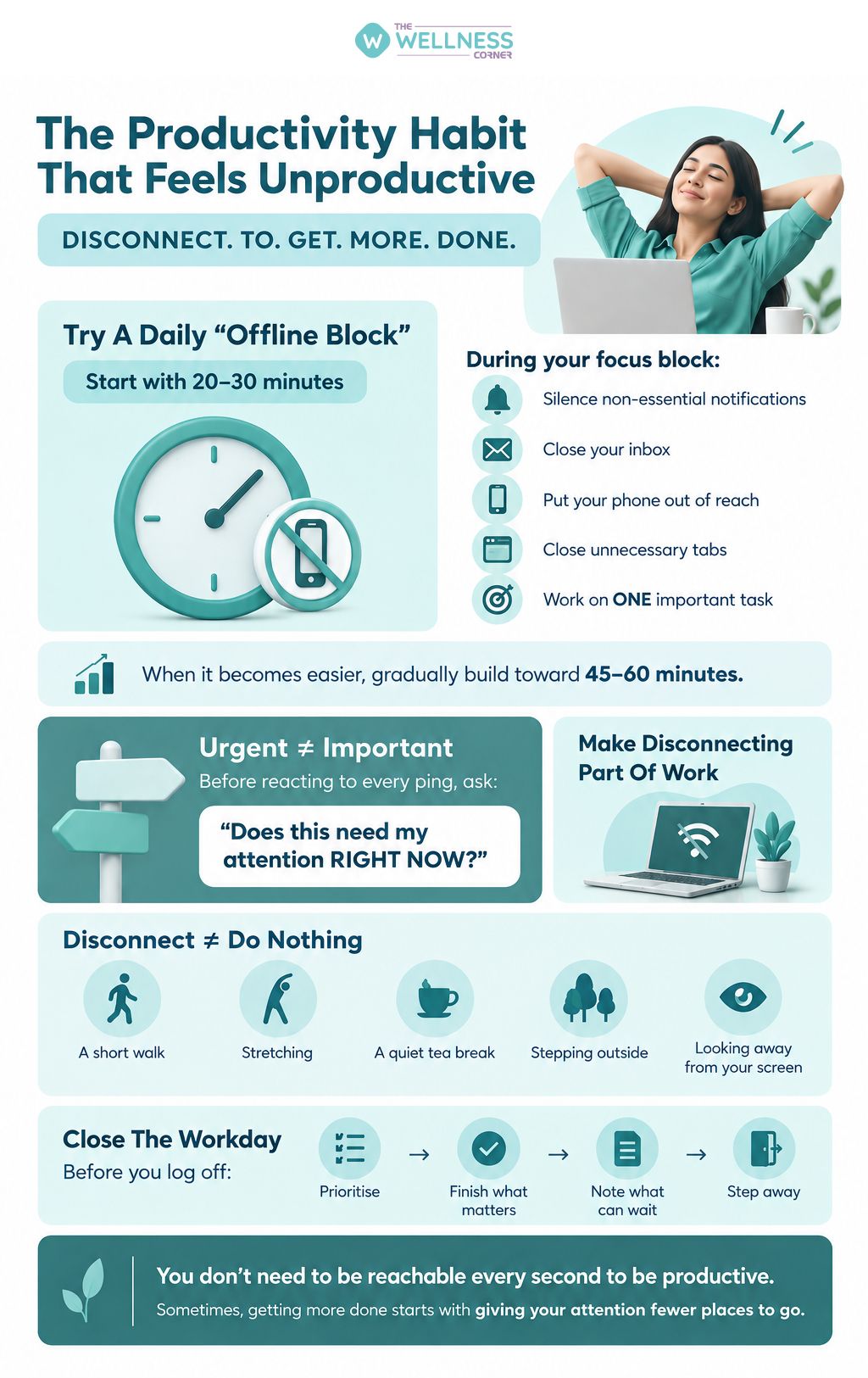
Try A Daily "Offline Block"
You do not need to disconnect for half a day to experience the benefits.
Start with 20 to 30 minutes.
Choose one task that requires concentration. Put your phone on silent, close unnecessary browser tabs, mute non-essential notifications, and avoid checking email during that period.
Then work on only that task.
As the habit becomes easier, increase the duration.
You could eventually create a 60-minute focus block during your workday.
The important part is consistency.
A short period of genuine focus can be more useful than several hours spent constantly switching between tasks.
Your Phone May Be The Biggest Distraction On Your Desk
Most people do not need their phone to complete every work task.
Yet it often remains within arm's reach.
A vibration, notification, message preview, or social media alert can immediately compete for your attention.
Try keeping your phone out of sight during focused work.
If you need it for work, disable notifications that are not urgent and use settings that allow only essential calls or messages to come through.
The goal is not to make your phone the enemy.
It is to stop your phone from deciding when your attention changes direction.
Also Read: How Social Media Is Shaping Youth Health And Wellness?

Disconnecting Can Also Improve Your Meetings
Constant connectivity does not only affect individual work.
It can affect conversations.
How often have you attended a meeting while simultaneously checking email?
You may technically be present, but your attention is divided.
A meeting where participants are fully engaged can be more productive than one where everyone is responding to messages under the table.
Where practical, try creating meeting norms that encourage participants to focus on the discussion rather than multitasking.
For short meetings, that may simply mean closing unrelated applications and keeping phones aside.
Don't Confuse Urgency With Importance
One of the hardest parts of disconnecting is the fear that something important might happen while you are unavailable.
But not every notification deserves an immediate response.
Ask yourself:
Does this require my attention right now, or can it wait?
Creating clear expectations with colleagues can help.
If your role allows it, let your team know when you are working on focused tasks and when you will be available again.
This reduces the pressure to remain constantly reachable.
Also Read: How To Manage Expectations And Pressure During Appraisal Week?

Create Boundaries Around Your Workday
Disconnecting should not stop when the laptop closes.
For people who work remotely or use personal devices for work, the boundary between professional and personal time can become especially blurry.
Checking work messages during dinner or responding to emails just before bed may make it harder to mentally switch off.
Where possible, establish a simple end-of-day routine.
Finish your priority tasks, check what genuinely needs attention, note what can wait until tomorrow, and then step away.
You are not abandoning work.
You are giving your brain a clear signal that the working day has ended.
The Productivity Boost May Come From Rest
Disconnecting is not only about avoiding distractions.
It also creates space for recovery.
Your brain cannot remain in high-alert mode indefinitely without consequences for attention and wellbeing.
Regular short pauses can help you feel refreshed and ready to continue. Stepping outside, stretching, walking, having a quiet cup of tea, or simply sitting away from a screen can provide a useful pause.
The objective is not to fill every break with another form of stimulation.
A brief period of doing nothing can give your brain valuable time to reset.

What About Digital Detoxes?
You do not need to disappear from technology for an entire weekend to benefit from disconnecting.
Large digital detoxes can sound appealing, but they are not always realistic for people with demanding jobs or family responsibilities.
Instead, think smaller.
A phone-free meal.
A notification-free focus block.
A screen-free walk.
An evening without checking work email.
A few minutes between meetings without immediately opening another app.
These small boundaries are easier to maintain and can gradually change your relationship with technology.
Also Read - Step Away From The Smartphone: How To Digital Detox?
Make Disconnecting A Workplace Habit
For organizations, disconnecting should not become an individual employee's responsibility alone.
Workplace culture matters.
If employees are expected to respond to messages at all hours, simply telling them to "switch off" may not solve the problem.
Teams can support healthier digital habits by setting realistic response expectations, reducing unnecessary meetings, respecting non-working hours, and creating uninterrupted focus periods.
Managers can also model these behaviours.
When leaders send emails late at night and expect immediate responses, employees may feel pressure to remain connected.
Healthy boundaries work best when they are supported by the culture around them.

The Bottom Line
Productivity is not about being available every second of the day.
Sometimes, it is about knowing when to become unavailable.
Disconnecting gives your attention room to settle, protects periods of deep focus, and creates opportunities for genuine recovery. It can also help you build healthier boundaries between work and personal life.
You do not need to switch off everything at once.
Start with one notification-free block today.
Put your phone away. Close your inbox. Select a key task and dedicate your full focus to completing it.
You may discover that getting more done starts with giving yourself permission to disconnect.
Looking for more practical ways to improve your mental wellbeing, work-life balance, and everyday health? Explore The Wellness Corner for expert guidance, wellness resources, and tools designed to help you build healthier habits at work and beyond.
Disclaimer: This article is intended for general educational and informational purposes only and should not replace professional mental health care, diagnosis, or treatment. Mindfulness and relaxation practices may affect individuals differently. If you are experiencing persistent emotional or psychological difficulties or they are affecting your daily life, consider speaking with a qualified mental health professional.

Leave a Comment

Sign-Up Now & Unlock
₹100 Cashback
Subscribe to our Newsletter!
Get a weekly dose of wellness tips delivered straight to your inbox.
Recently Published
Related Articles


Health Checks @ Home
Service
Explore



Follow us on:


© 2026 Truworth Health Technologies Pvt. Ltd.