How Short Videos Are Rewiring Your Attention Span?
3 months ago
6 minute read.

You pick up your phone intending to glance at a single notification.
A few minutes later, you have watched 20 videos.
You cannot remember most of them.
Yet somehow, half an hour has disappeared.
For millions of people, this experience has become part of daily life.
Short-form videos have transformed how people consume content. Digital platforms featuring an endless flow of short videos have become a major force in online entertainment.
- The appeal is obvious.
- The videos are fast.
- They are entertaining.
- They require little effort.
- They deliver instant novelty.
But as short-form content becomes increasingly common, many people are starting to ask an important question:
Are short videos changing the way we pay attention?
Researchers continue to study the long-term effects of digital media on attention and cognition. While short videos are not inherently harmful, their growing influence on daily habits has sparked conversations about focus, concentration, and mental well-being.
Also Read: How Social Media Is Shaping Youth Health And Wellness?
The Rise Of The Bite-Sized Content Era
Not long ago, people regularly consumed longer forms of content.
- Books.
- Newspaper articles.
- Television programs.
- Long-form videos.
- Extended conversations.
Today, attention often shifts every few seconds.
Many digital platforms are built around content that lasts anywhere from a few seconds to a minute.
The goal is simple:
- Capture attention immediately.
- Maintain engagement.
- Deliver constant novelty.
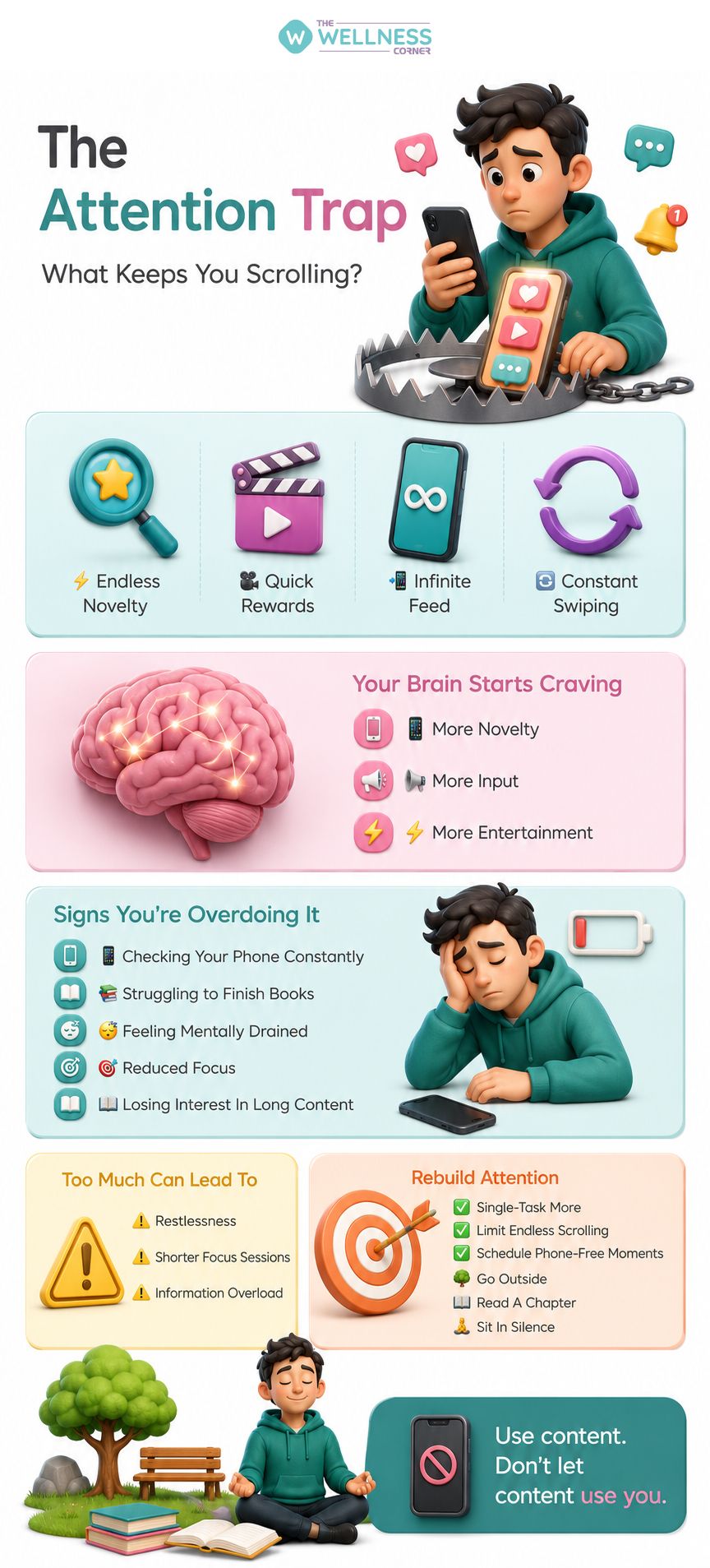
This model has proven incredibly effective because the human brain naturally responds to new and interesting information.
Why Short Videos Feel So Rewarding?
The brain is constantly searching for information that feels rewarding, surprising, or emotionally engaging.
Short videos provide all three.
Every swipe introduces something new:
- A joke.
- A life hack.
- A recipe.
- A fitness tip.
- A travel clip.
- A trending challenge.
Since viewers are unsure about what the next video will bring, the experience often feels engaging, surprising, and highly stimulating.
This constant novelty encourages repeated engagement and keeps people scrolling longer than they originally intended.
The Attention Economy Is Competing For Your Focus
Modern digital platforms operate within what many experts call the "attention economy."
In simple terms, attention has become a valuable resource.
Apps, websites, and content creators compete to capture and hold user attention for as long as possible.
To achieve this, platforms often rely on:
- Infinite scrolling
- Personalized recommendations
- Quick rewards
- Constant updates
- Continuous content streams
These design elements are intended to keep users interacting with the platform for longer periods.
As a result, many people consume far more information than previous generations ever did.
How Constant Stimulation May Affect Focus?
The brain is remarkably adaptable.
It learns from repeated patterns.
When people spend significant amounts of time consuming rapid, constantly changing content, the brain may become accustomed to frequent stimulation.
Over time, slower activities may begin to feel less engaging.
Some people notice difficulty focusing on:
- Books
- Long articles
- Meetings
- Studying
- Extended conversations
- Complex projects
This does not necessarily mean attention spans are permanently damaged.
However, repeated exposure to highly stimulating content may influence how attention is allocated.

Why Boredom Feels Different Today?
Boredom once played an important role in everyday life.
People experienced quiet moments while:
- Waiting in line
- Travelling
- Sitting alone
- Walking outdoors
These moments often allowed the mind to:
- Reflect
- Problem-solve
- Daydream
- Process emotions
Today, boredom rarely lasts.
The moment discomfort appears, many people instinctively reach for their phones.
As a result, opportunities for mental downtime may become less frequent.
Also Read: This Japanese Walking Technique Is Better Than 10,000 Steps - Doctor Explains Why?
The Impact On Deep Work And Learning
Many valuable activities require sustained concentration.
Examples include:
- Reading
- Writing
- Studying
- Learning new skills
- Creative problem-solving
- Professional work
These activities often involve delayed rewards rather than immediate gratification.
When the brain becomes accustomed to rapid stimulation, longer tasks may feel more challenging.
This is one reason many people report difficulty staying focused on a single activity for extended periods.

Why Multitasking Often Feels Necessary?
Frequent exposure to short-form content may encourage people to switch their attention between tasks more often.
Many individuals now:
- Watch videos while eating
- Scroll while watching television
- Check notifications during conversations
- Browse social media while working
Although this may feel productive, constantly switching attention can increase mental fatigue.
The brain performs best when it can focus on one task at a time.
Also Read: 10 Reasons Why You Should Stop Multitasking
The Emotional Effects Of Constant Scrolling
Attention is not the only area affected by excessive content consumption.
Many people also experience:
- Mental fatigue
- Information overload
- Restlessness
- Difficulty relaxing
- Increased stress
The sheer volume of content consumed each day can sometimes leave the brain feeling overstimulated.
This is particularly true when videos involve emotionally charged or highly stimulating material.
Are Short Videos Always Bad?
Not at all.
Short videos can offer many benefits.
They may provide:
- Education
- Entertainment
- Motivation
- Quick learning opportunities
- Creative inspiration
- Social connection
The issue is rarely the content format itself.
The challenge often arises when consumption becomes excessive or begins replacing activities that require deeper engagement.
Balance remains the key.
Also Read - Secrets To Never Losing Motivation: Types And Its Link To Productivity
Signs Short Videos May Be Affecting Your Attention
Some people may notice patterns such as:
- Difficulty finishing books
- Constantly checking the phone
- Feeling restless during quiet moments
- Frequently switching between tasks
- Struggling to focus during meetings
- Needing constant background stimulation
These behaviors do not necessarily mean there is a significant issue, but they may be worth paying attention to.
However, they may signal a need to evaluate digital consumption patterns.

How To Strengthen Your Attention Span Again?
The encouraging news is that attention is trainable.
Just as muscles adapt to exercise, the brain can strengthen focus through intentional habits.
1. Schedule Screen-Free Time
Creating short periods without digital stimulation may help improve concentration and mental clarity.
2. Practice Single-Tasking
Focus on one activity at a time rather than juggling multiple tasks simultaneously.
3. Read Longer Content Regularly
Books, articles, and long-form content help exercise sustained attention.
4. Allow Yourself To Experience Boredom
Not every moment of silence or downtime needs to be occupied by digital content or distractions.
Occasional boredom can encourage creativity and reflection.
5. Set Limits On Endless Scrolling
Small boundaries around screen use may help reduce overstimulation and improve focus.
Why Attention Is Becoming A Modern Health Topic?
Attention influences many aspects of daily life, including:
- Productivity
- Learning
- Relationships
- Decision-making
- Emotional regulation
- Mental well-being
As digital environments become increasingly immersive, protecting attention may become an important part of overall wellness.
Just as people care for physical health, many are beginning to pay closer attention to cognitive and emotional health as well.
Also Read: Relationship Strengthening Conversations Every Couple Needs To Have
The Bigger Picture: Your Attention Is One Of Your Most Valuable Resources
Short videos are not inherently harmful.
They can entertain, educate, and inspire.
However, when constant stimulation becomes the default setting, deeper forms of focus may become harder to maintain.
Attention shapes how people learn, work, communicate, and experience life.
Being intentional about where attention goes may be one of the most important wellness habits in today's digital world.
The goal is not to eliminate short-form content completely.
The goal is to use it consciously rather than allowing it to consume every spare moment.
Build Healthier Digital Habits With The Wellness Corner
Mental wellness, focus, stress management, sleep quality, and healthy lifestyle habits are closely connected.
The Wellness Corner offers expert-backed support for emotional wellness, mindfulness, fitness, nutrition, preventive care, and healthier lifestyle choices to help individuals build balance in an increasingly digital world.
Because taking care of your mind is just as important as taking care of your body.
Frequently Asked Questions (FAQs)
Leave a Comment

Sign-Up Now & Unlock
₹100 Cashback
Recently Published
Related Articles


Health Checks @ Home
Service
Explore



Follow us on:


© 2026 Truworth Health Technologies Pvt. Ltd.