Why Online Conversations Are Often Misleading: Understanding Digital Body Language Misinterpretations
2 months ago
7 minute read.

A friend replies with a simple "Okay."
A colleague takes several hours to respond to your email.
A person reads your message, but no response follows.
Suddenly, your mind starts filling in the blanks.
Are they upset?
Did you say something wrong?
Are they ignoring you?
In many cases, none of those assumptions are true.
Yet misunderstandings like these happen every day.
As more of our communication takes place through screens, a new challenge has emerged: interpreting what people mean without the benefit of face-to-face interaction.
This phenomenon is often referred to as digital body language.
Just as traditional body language helps people interpret emotions and intentions in person, digital body language involves the cues people send through emails, texts, messaging apps, video calls, and social media interactions.
The challenge is that these cues are often limited in context, open to multiple interpretations, and prone to misunderstanding.
Also Read - Power Poses: Feel More Confident With Body Language
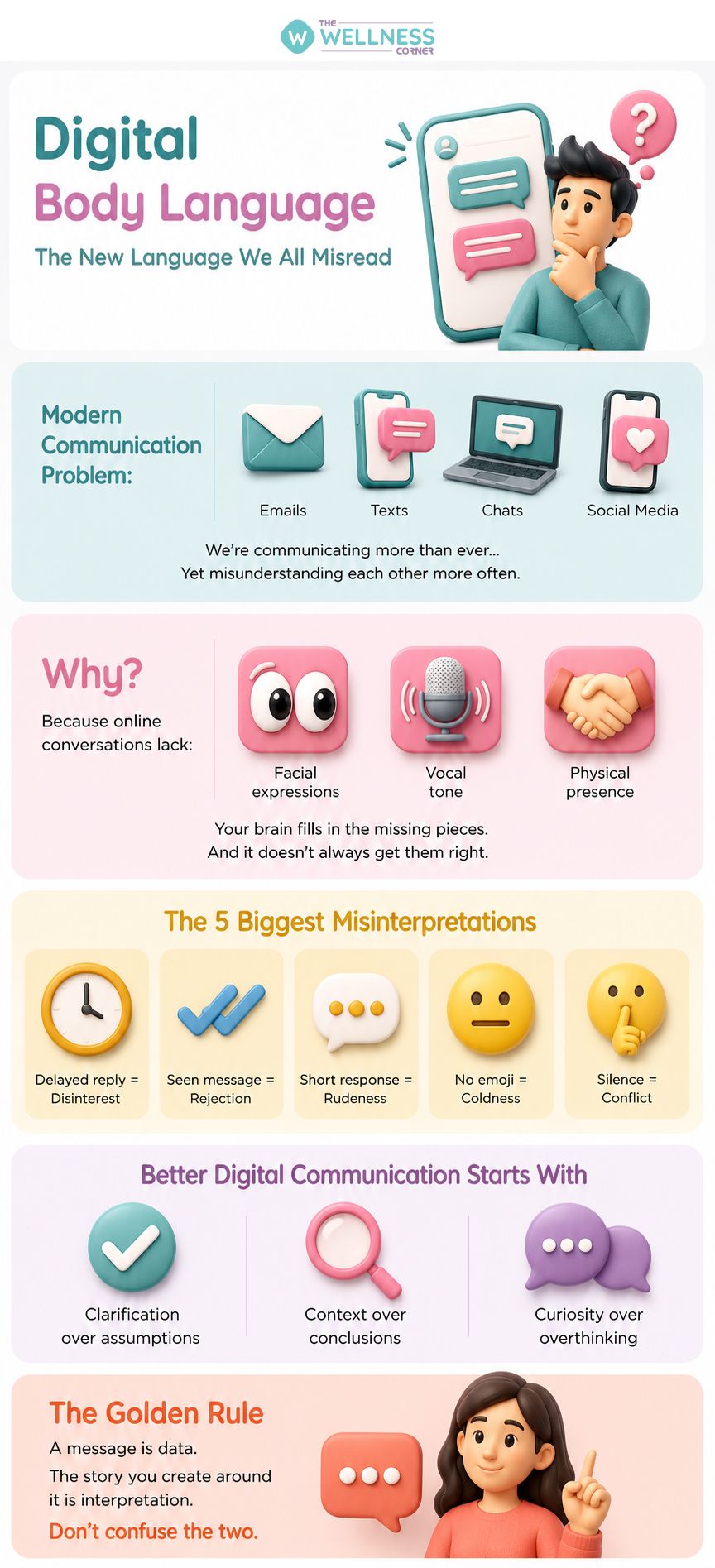
What Is Digital Body Language?
Digital body language refers to the way people communicate emotions, attitudes, intentions, and engagement through online interactions.
Unlike face-to-face communication, digital conversations rely on signals such as:
- Response times
- Typing patterns
- Word choice
- Punctuation
- Emojis
- Read receipts
- Email formatting
- Message length
- Online availability indicators
These cues often influence how messages are interpreted, even when the sender never intended a particular meaning.
Also Read - The Anxiety Of Typing… And Deleting: Overthinking Your Messages
Why Human Communication Relies On More Than Words?
Communication is about much more than spoken language.
In face-to-face conversations, people also rely on:
- Facial expressions
- Eye contact
- Tone of voice
- Body posture
- Gestures
- Physical presence
These nonverbal signals provide important context.
They help people determine whether someone is:
- Happy
- Sarcastic
- Nervous
- Interested
- Angry
- Supportive
When communication moves online, many of these signals disappear.
As a result, people are often left to interpret meaning using limited information.
Also Read: Nervousness - Is It Different From Anxiety Or The Same?

The Brain Naturally Fills In Missing Information
Humans are naturally wired to seek meaning.
When information is incomplete, the brain often fills in the gaps using assumptions, past experiences, and emotions.
This tendency can be helpful in some situations.
However, in digital communication, it frequently creates misunderstandings.
For example:
- A short message may be interpreted as rude.
- A delayed response may be interpreted as rejection.
- A missing emoji may be interpreted as annoyance.
In reality, the sender may simply be busy, distracted, or communicating differently than expected.
Why Text Messages Are Especially Easy To Misread?
Text messages remove many of the cues that help people interpret intent.
Consider the difference between these two statements:
"Sure."
"Sure"
The words are identical.
The emotional tone feels completely different.
Without vocal tone or facial expressions, small details often carry more weight than intended.
As a result, individuals may read emotions or intentions into a message that the sender never meant to convey.
The Hidden Meaning People Attach To Response Times
Response speed has become one of the most commonly misinterpreted forms of digital body language.
Many individuals, often without realizing it, interpret response speed as an indicator of:
- Interest
- Respect
- Friendship
- Commitment
- Professionalism
Also Read: How To Deal With Outgrowing Friendships?
For example, a delayed reply might trigger assumptions such as:
- "They are ignoring me."
- "They must be upset."
- "They are losing interest."
However, response times are often influenced by factors such as:
- Work schedules
- Family responsibilities
- Meetings
- Time zones
- Mental workload
- Personal communication preferences
A delayed response does not automatically indicate a negative message.
How Read Receipts Create Anxiety?
Modern messaging platforms often show when messages have been delivered, viewed, or read.
While these features can improve transparency, they can also increase overthinking.
Many people have experienced situations where:
- A message was read but not answered.
- A reply took longer than expected.
- An online status appeared active without a response.
These situations may create unnecessary stress because people often assume intentions without having complete information.
Also Read: Signs You Might Have High-Functioning Anxiety

The Problem With Overanalyzing Short Messages
Digital communication encourages brevity.
Many people type quickly and communicate efficiently.
However, brief messages are frequently interpreted as emotionally distant.
Examples include:
- "Okay."
- "Thanks."
- "Noted."
- "Sure."
- "Fine."
Depending on the reader's mood or expectations, these messages may appear:
- Cold
- Dismissive
- Passive-aggressive
- Unfriendly
Yet the sender may simply be communicating efficiently.
Emojis: Helpful But Not Foolproof
Emojis were introduced partly to help replace missing emotional cues.
They can provide additional context and reduce ambiguity.
However, emojis are not universally interpreted in the same way.
Different generations, cultures, and individuals may assign different meanings to the same symbol.
An emoji intended as friendly may be interpreted as sarcastic.
A joking message may be interpreted as serious.
Even digital emotional cues have limitations.

Workplace Communication Is Especially Vulnerable
Digital body language plays an increasingly important role in professional environments.
Remote work, hybrid schedules, and virtual collaboration have transformed how teams communicate.
Employees often interpret workplace signals such as:
- Email response speed
- Meeting participation
- Message length
- Use of punctuation
- Availability indicators
- Silence during discussions
Unfortunately, these cues can sometimes lead to inaccurate conclusions.
A colleague's delayed response may have nothing to do with their level of engagement or commitment.
Why Stress Increases Misinterpretation?
Emotional state significantly affects how messages are perceived.
When people are stressed, anxious, or overwhelmed, they may become more likely to interpret ambiguous communication negatively.
For example, someone experiencing stress may view a neutral message as:
- Critical
- Judgmental
- Dismissive
- Hostile
The message itself may not be negative at all.
The interpretation may simply reflect the emotional state of the reader.

Social Media Adds Another Layer Of Complexity
Social media creates additional opportunities for digital body language misreads.
People often analyze:
- Likes
- Comments
- Views
- Story interactions
- Follower activity
- Online status indicators
A missing interaction can sometimes feel personal.
Yet social media behavior is influenced by countless factors that have nothing to do with relationships.
Assumptions based solely on digital activity often fail to reflect reality.
Also Read: How Social Media Is Shaping Youth Health And Wellness?
Why Context Matters More Than Individual Messages?
One of the biggest mistakes people make is interpreting a single message in isolation.
Context is essential.
A brief response from someone who consistently communicates that way may be perfectly normal.
A delayed reply from someone facing a demanding week may have no emotional significance whatsoever.
Examining overall communication habits and trends usually offers a clearer understanding than drawing conclusions from a single exchange.
How To Reduce Digital Communication Misunderstandings?
Fortunately, a few practical strategies can help make digital communication clearer and reduce misunderstandings.
1. Avoid Jumping To Conclusions
Pause before assigning meaning to ambiguous messages.
2. Ask For Clarification
If something feels unclear, direct communication is often more effective than assumptions.
3. Consider Alternative Explanations
There may be many reasons for a delayed response or short message.
4. Use Clear Communication
Providing context and clarity can reduce confusion.
5. Recognize Emotional Biases
Your current mood may influence how you interpret messages.
The Future Of Human Communication
With ongoing technological developments, digital communication will continue to play a central role in the way people communicate, work together, and maintain relationships.
While digital tools offer convenience and connection, they cannot fully replace the richness of face-to-face interaction.
Understanding digital body language can help people navigate online conversations with greater awareness, empathy, and patience.
Sometimes the message we imagine is very different from the message that was actually sent.
The Bigger Picture: Not Every Message Means What You Think
Most people have misread a text, email, or social media interaction at some point.
It is a natural consequence of communicating through screens.
Digital communication removes many of the emotional cues humans rely on to understand one another.
As a result, misunderstandings are often less about what was said and more about what was assumed.
Learning to slow down, seek context, and communicate openly can help reduce unnecessary stress and strengthen relationships in an increasingly digital world.
Support Emotional Well-Being With The Wellness Corner
Healthy communication is closely connected to emotional wellness, stress management, and relationship health.
The Wellness Corner offers expert-backed support for mental wellness, mindfulness, emotional resilience, stress management, preventive care, and healthier lifestyle habits that help individuals navigate both online and offline challenges more effectively.
Because better communication often starts with greater self-awareness.
Frequently Asked Questions (FAQs)
Leave a Comment

Sign-Up Now & Unlock
₹100 Cashback
Recently Published
Related Articles


Health Checks @ Home
Service
Explore



Follow us on:


© 2026 Truworth Health Technologies Pvt. Ltd.