Why Do We Always Think Of The Perfect Response Hours After A Conversation Is Over?
2 months ago
6 minute read.

Have you ever walked away from a conversation only to think of the perfect comeback, explanation, or answer hours later?
Perhaps it happened after a meeting, when the point you wanted to make finally came to mind. Perhaps it was during a disagreement when the ideal response suddenly appeared while you were brushing your teeth that night. Or maybe it happened after a job interview, and you spent the next several hours replaying every question and imagining better answers.
If this has ever happened to you, you're far from the only one.
This experience even has its own name. The French call it l'esprit de l'escalier, which translates to "staircase wit." It refers to thinking of the perfect response only after you've left the conversation and are already heading down the stairs.
But why does this happen so often?
The answer lies in the way our brains process information, emotions, social interactions, and stress. Understanding this phenomenon can help you stop being overly critical of yourself and become more confident in future conversations.
Also Read - Power Poses: Feel More Confident With Body Language
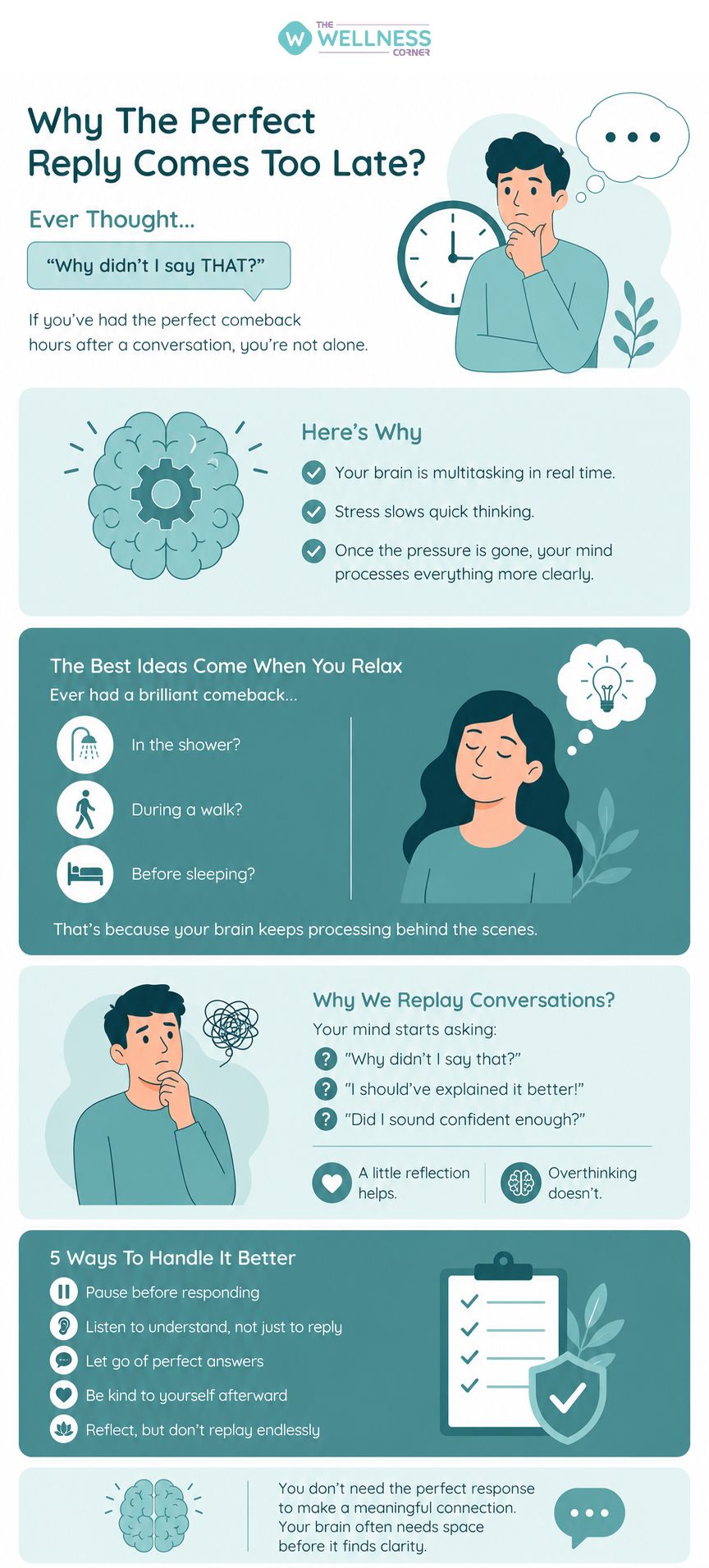
The Brain Doesn't Always Perform Best Under Pressure
Most conversations happen in real time.
Unlike writing an email or preparing a presentation, conversations require immediate responses. Your brain has only seconds to process information, understand context, interpret emotions, and formulate a reply.
That's a lot of work.
During live interactions, your brain is simultaneously trying to:
- Listen carefully
- Understand what is being said
- Read facial expressions and body language
- Monitor your own reactions
- Decide what to say next
- Consider how your response may be perceived
Because so many mental processes are happening at once, it's not surprising that your best ideas sometimes arrive later when the pressure has disappeared.
Why Hindsight Feels So Much Easier?
Once a conversation ends, your brain is no longer multitasking.
The social pressure is gone.
The need for an immediate response disappears.
You suddenly have more mental space to analyze what happened.
This allows your brain to revisit the interaction and process information more deeply. Without the stress of performing in the moment, creative thinking often becomes easier.
In some respects, your brain functions much like a computer. When too many applications are running simultaneously, performance can slow down. Once those demands are removed, resources become available for clearer thinking.
That delayed clarity is often when the "perfect response" appears.
Also Read: Psychology-Backed Ways To Deal With People Who Stress You Out

The Role Of Stress In Conversation
Stress plays a major role in how effectively we communicate.
When we feel nervous, challenged, embarrassed, or pressured, our body's stress response becomes activated.
This response can temporarily affect:
- Memory retrieval
- Verbal fluency
- Concentration
- Decision-making
- Creative thinking
Even mild social stress can interfere with our ability to access information we already know.
Have you ever forgotten someone's name moments after being introduced, only to remember it later?
The same principle applies during conversations.
The information was always there. Your brain simply struggled to retrieve it under pressure.
Why We Replay Conversations In Our Heads?
Many people mentally revisit conversations long after they end.
Psychologists often refer to this as rumination.
Rumination involves repeatedly thinking about past events, interactions, or decisions.
After a conversation, your brain may naturally ask questions such as:
- What should I have said?
- Why didn't I mention that point?
- Did I sound confident enough?
- Could I have handled that better?
While occasional reflection can be helpful, excessive replaying can increase stress and self-doubt.
The important thing to remember is that most people are far less focused on your responses than you think.
In reality, they are usually thinking about their own performance, concerns, and conversations.

Perfectionism Makes The Problem Worse
People who hold themselves to extremely high standards often experience this phenomenon more intensely.
Perfectionists frequently believe that every conversation requires the perfect answer.
The problem is that real-life communication doesn't work that way.
Conversations are dynamic, unpredictable, and imperfect.
Nobody consistently delivers flawless responses in every interaction.
When perfection becomes the goal, it's easy to become overly critical of natural human mistakes.
Instead of focusing on finding the ideal response, it can be more helpful to focus on communicating authentically and effectively.
Also Read: The Vice Called Perfectionism
Your Brain Continues Working Behind The Scenes
One fascinating aspect of human cognition is that the brain often continues processing information even after an event has ended.
Researchers have found that problem-solving frequently occurs during periods of rest.
This is why solutions sometimes appear:
- During a walk
- In the shower
- Before falling asleep
- While driving
- During unrelated activities
The same process can happen after conversations.
Your brain continues organizing information, identifying patterns, and evaluating responses long after the interaction ends.
What feels like a sudden flash of brilliance is often the result of ongoing subconscious processing.
Also Read - Everything Shower: What It Is & Why Everyone Loves It?

Why Introverts Often Relate To This Feeling?
Anyone can think of the perfect response later, though introverts often report it happening more frequently.
Many introverts naturally prefer reflection before responding.
They tend to process information internally and may require additional time to organize their thoughts.
In fast-paced conversations, this processing style can create a delay between hearing information and formulating a response.
That delay doesn't indicate poor communication skills.
It simply reflects a different way of thinking.
In many cases, thoughtful reflection can actually lead to deeper insights and more meaningful communication.
How To Become More Comfortable In Conversations?
While you may never eliminate staircase wit entirely, there are ways to reduce its impact.
1. Permit Yourself To Pause
Not every response needs to be immediate.
Taking a moment to think before speaking often leads to better communication.
2. Focus On Listening
Many people become so concerned about what they will say next that they stop fully listening.
Active listening often improves the quality of responses naturally.
3. Let Go Of Perfection
The goal of conversation is connection, not perfection.
Most interactions do not require a flawless answer.
4. Practice Self-Compassion
Treat yourself with the same understanding you would offer a friend.
Everyone occasionally thinks of better responses after the fact.

5. Reflect Without Overanalyzing
Constructive reflection can help you grow.
Obsessive replaying usually creates unnecessary stress.
The Hidden Benefit Of Thinking Later
Interestingly, delayed responses are not always a disadvantage.
The fact that you continue reflecting on conversations often demonstrates:
- Self-awareness
- Emotional intelligence
- Critical thinking
- A desire to communicate effectively
The goal isn't to eliminate these tendencies but to balance them.
Instead of criticizing yourself for not finding the perfect words immediately, recognize that thoughtful processing is a normal part of how the human mind works.
Final Thoughts
Thinking of the perfect response hours after a conversation ends is a common human experience. It happens because our brains often function differently under pressure than they do during reflection.
Stress, multitasking, social expectations, perfectionism, and natural cognitive processing all contribute to this phenomenon.
The next time you find yourself replaying a conversation and discovering the ideal response too late, remember that it doesn't mean you failed in the moment. It simply means your brain continued working on the problem after the conversation ended.
Communication is not about always having the perfect answer. It is about being present, authentic, and willing to learn from each interaction.
Strengthen Your Mental Well-Being With The Wellness Corner
Understanding how your mind works is an important step toward better emotional health and self-confidence. Whether you're managing stress, building resilience, improving communication skills, or supporting your overall mental well-being, small insights can lead to meaningful personal growth.
The Wellness Corner offers expert-backed guidance on mental wellness, stress management, mindfulness, emotional health, nutrition, fitness, and preventive care to help you thrive both personally and professionally.
Frequently Asked Questions (FAQs)
Leave a Comment

Sign-Up Now & Unlock
₹100 Cashback
Subscribe to our Newsletter!
Get a weekly dose of wellness tips delivered straight to your inbox.
Recently Published
Related Articles


Health Checks @ Home
Service
Explore



Follow us on:


© 2026 Truworth Health Technologies Pvt. Ltd.