How To Keep Exercising When You Can’t Get To The Gym?
15 days ago
6 minute read.

You planned your workout. Your shoes are ready, your playlist is set, and then something gets in the way. Maybe the gym is closed, your schedule suddenly fills up, you're travelling, or you simply cannot leave home.
Does that mean your fitness routine has to stop?
Not at all.
One missed gym session will not erase your progress. In fact, learning how to adapt your workout when your usual environment is unavailable can make your fitness routine more sustainable in the long run. The key is to stop thinking about the gym as the workout itself. The gym is simply one place where you exercise.
Whether you have a few minutes at home, access to a park, or nothing more than your own body weight, there are plenty of ways to keep moving.
Also Read: 5 Exercising Mistakes That Can Increase Anxiety (Instead Of Reducing It)
Start By Changing Your Mindset, Not Your Workout
The first adjustment is psychological.
It is easy to think, "If I cannot do my usual workout, there is no point exercising." This all-or-nothing approach can turn one missed session into several days of inactivity.
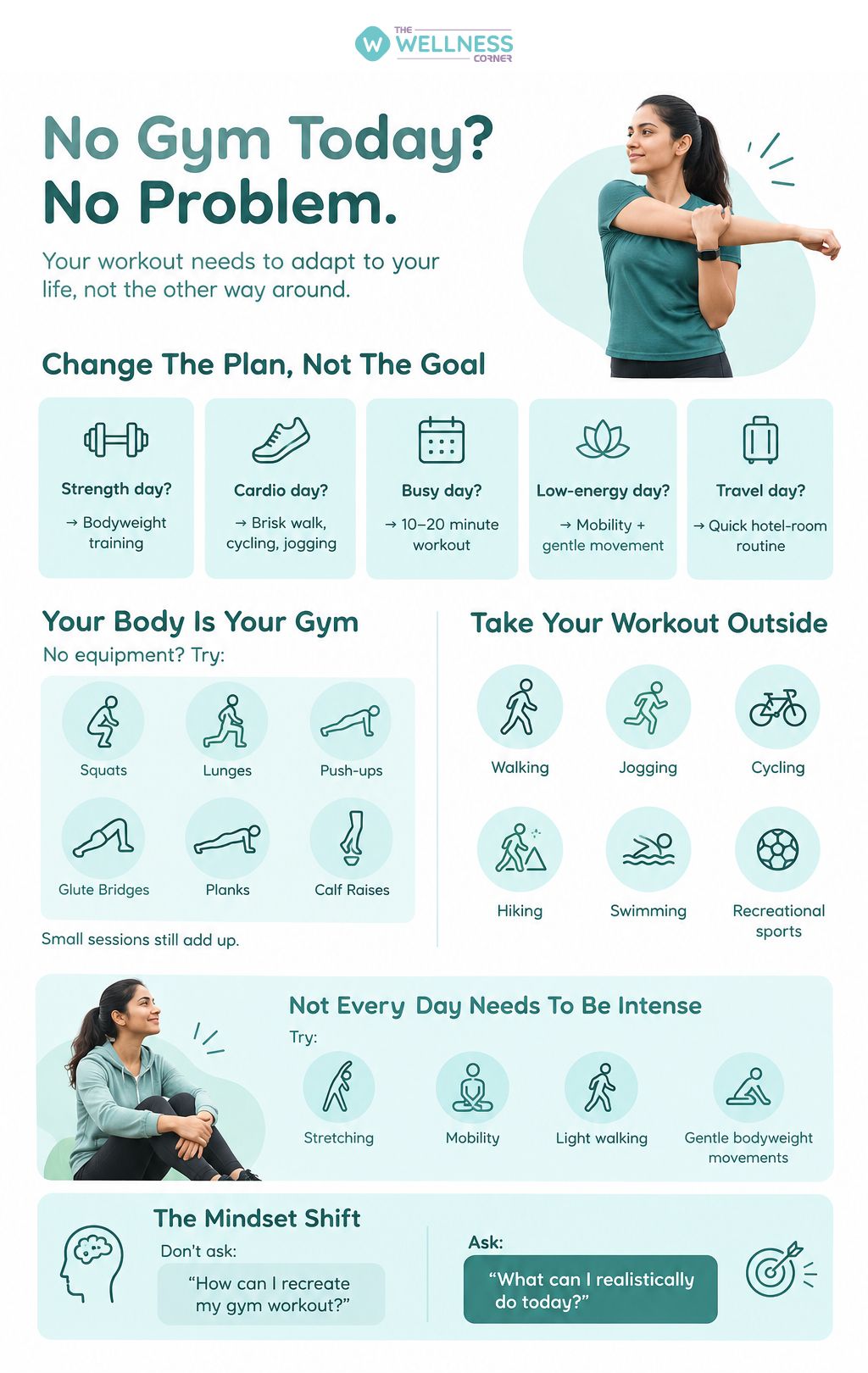
Instead, ask yourself: What can I realistically do today?
Your alternative workout does not have to replicate your gym session perfectly. It simply needs to provide some useful movement.
If you normally spend an hour lifting weights, a 20-minute bodyweight session can still challenge your muscles. If you usually run on a treadmill, a brisk outdoor walk can keep you active.
Consistency matters more than perfection.
Use Your Body Weight As Your Equipment
You do not always need dumbbells or machines to create a challenging workout.
Bodyweight exercises can target major muscle groups while requiring very little space. Depending on your fitness level, you can build a session around movements such as:
- Squats
- Reverse lunges
- Glute bridges
- Push-ups
- Planks
- Mountain climbers
- Calf raises
The trick is to adjust repetitions, sets, tempo, or rest periods according to your ability.
For example, slowing down the lowering phase of a squat can make a familiar movement more challenging. You can also use single-leg variations or increase the number of repetitions if appropriate.
Focus on controlled movement rather than simply trying to make the workout exhausting.
Also Read: Should I Do Deadlifts Or Squats First?

Turn Your Home Into A Mini Fitness Studio
Your home may contain more useful workout options than you realize.
A sturdy chair can assist with certain exercises, while stairs can provide an opportunity for step-ups or short bouts of cardiovascular activity. A backpack filled with appropriate household items can sometimes provide additional resistance for selected exercises.
However, safety comes first. Avoid using unstable furniture or objects that can break, slide, or tip over.
You do not need an elaborate home gym. A small, clear space on the floor may be enough for a productive session.
Short On Time? Make Your Workout Smaller
When your schedule is packed, do not assume you need to find a full hour.
A shorter workout can still be worthwhile.
Try dividing movement throughout the day. You could complete a 10-minute workout in the morning, take a brisk walk during lunch, and spend another 10 minutes doing mobility exercises in the evening.
Short sessions can also help remove the mental barrier of thinking you need a large block of free time before you can exercise.
When time is limited, prioritize the exercises that provide the most value. Compound movements that involve several muscle groups can be particularly useful.
Also Read: How To Improve Flexibility And Mobility Without Stretching?

Take Your Cardio Outdoors
If you cannot access cardio machines, look outside.
Walking, jogging, cycling, hiking, swimming, or recreational sports can provide opportunities to improve cardiovascular fitness, depending on your health, fitness level, and surroundings.
Even a faster-paced walk can be a practical alternative when running is not appropriate.
Outdoor activity can also provide a change of environment, which may make movement feel less repetitive than exercising indoors.
If weather or safety makes outdoor exercise unsuitable, consider indoor options such as marching in place, dancing, stair climbing, or a low-impact cardio routine.
Focus On Mobility When Your Body Needs A Break
Not every day has to be a hard training day.
If you have been travelling, working long hours, sleeping poorly, or feeling physically fatigued, your alternative workout can focus on mobility and gentle movement.
Try exercises such as:
- Shoulder rolls
- Hip mobility movements
- Gentle spinal rotations
- Ankle movements
- Light stretching
- Controlled bodyweight squats
Mobility work can help you stay active without turning every workout into an intense session.
Listen to your body and adjust the intensity accordingly.
Also Read: When Is Stretching Necessary And When Is It A Waste Of Time?

Travelling? Build A Portable Workout
Travel can disrupt even the most consistent fitness routine.
Instead of abandoning your routine completely, create a simple travel workout that requires little or no equipment.
For example, you could combine squats, lunges, push-ups, glute bridges, planks, and brisk walking.
Resistance bands can also be convenient for people who regularly travel and want an easily portable training option.
The goal is not to reproduce your exact gym program in a hotel room. It is to maintain your movement habit while adapting to your surroundings.
Replace The Routine, Not The Goal
One of the biggest mistakes people make when they cannot reach the gym is trying to recreate their normal workout exactly.
That may not be realistic.
If your usual routine involves heavy resistance training, you may not be able to replicate the same load at home. Instead, identify the purpose of the workout.
Was it designed to build strength? Improve cardiovascular fitness? Train mobility? Support general conditioning?
Once you know the goal, you can choose another activity that works toward the same outcome.
This approach gives you flexibility without losing direction.
Also Read: Should You Change Your Workout With The Seasons?
Know When Rest Is Actually The Better Choice
Adapting your workout does not mean forcing yourself to exercise every time your gym plans change.
Sometimes your body genuinely needs recovery.
If you are experiencing significant muscle soreness, unusual fatigue, pain, illness, dizziness, or other concerning symptoms, pushing through another workout may not
be the smartest decision.
Rest, sleep, hydration, and adequate nutrition are all important parts of fitness.
Missing one workout because you need recovery is very different from giving up on exercise altogether.

Create A "No Gym" Backup Plan
The best time to create an alternative workout is before you need one.
Write down two or three routines you can perform without gym equipment. Keep one short option for busy days, one moderate workout for normal days, and one mobility-focused routine for recovery days.
This removes the need to make decisions when your schedule suddenly changes.
You can also identify simple movement opportunities around your daily routine, such as taking the stairs, walking during phone calls, or taking short activity breaks during prolonged periods of sitting.
The easier your backup plan is to follow, the more likely you are to use it.
Frequently Asked Questions
Leave a Comment

Sign-Up Now & Unlock
₹100 Cashback
Recently Published
Related Articles


Health Checks @ Home
Service
Explore



Follow us on:


© 2026 Truworth Health Technologies Pvt. Ltd.