Social Fitness Vs. Personal Limits: How To Enjoy Group Workouts Without Overdoing It?
10 days ago
7 minute read.

There is something motivating about working out with other people.
A group class can make exercise feel less like a chore and more like a social activity. You have people encouraging you, music pushing the energy up, a trainer counting down the final few seconds, and friends who expect you to show up.
That atmosphere can be incredibly motivating.
But it can also make it surprisingly easy to ignore your own limits.
You may keep going because everyone else is still exercising. You may increase the weights because your workout partner is lifting more. You may push through pain because you do not want to be the person who stops first.
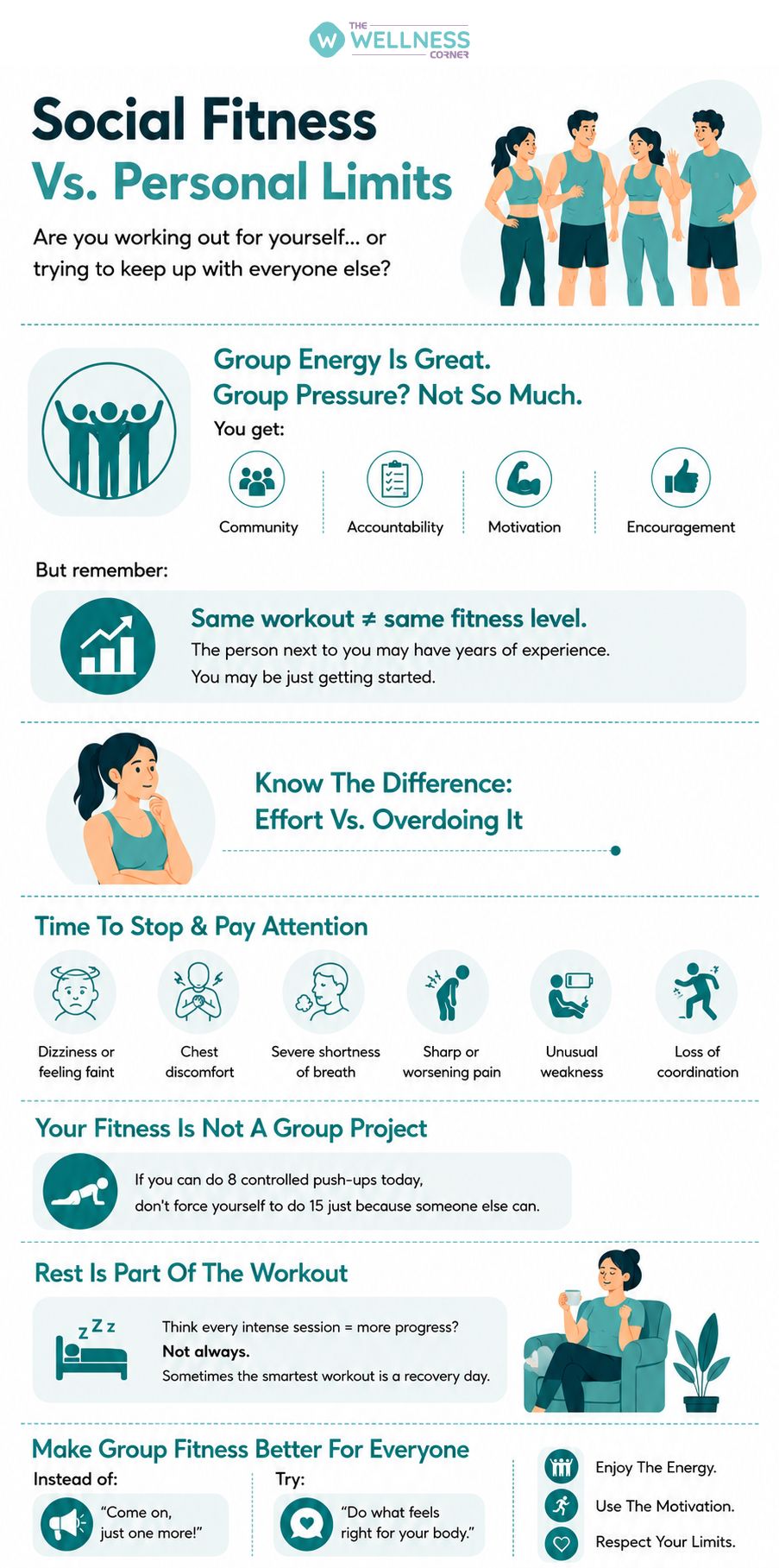
This is where the idea of social fitness becomes important. Exercise can be more enjoyable and consistent when shared with others, but your fitness journey still needs to match your body, experience, recovery, and goals.
The trick is not choosing between group workouts and personal limits. It is learning how to enjoy both.
Also Read: Why You Keep Quitting Your Workouts? (And the 5-Minute Fix To Stay On Track)
Why Group Workouts Feel So Motivating?
Group exercise comes with a psychological advantage that solo workouts do not always offer.
When other people are moving, sweating, and encouraging one another, you may feel more accountable. A scheduled class can also make it easier to stick to a routine.
There is another benefit: social connection.
You may look forward to seeing familiar faces, chatting before class, or celebrating progress together. For many people, that social element can turn exercise into a habit rather than something they repeatedly have to force themselves to do.
The problem starts when motivation turns into competition.
When Motivation Quietly Becomes Pressure?
Friendly competition can be fun.
But there is a difference between feeling inspired by someone and feeling like you have to keep up with them.
You may begin thinking:
“Everyone else is going faster. I should too.”
“What if I am the only person who needs to pause?”
“My friend is using a heavier load, and I feel like I should match it.”
“Seeing the group move forward makes me hesitant to pause.”
These thoughts can encourage you to exercise beyond what your current fitness level allows.
Group workouts are built for shared participation, not identical ability. The person next to you may have years of training behind them. You may be coming back after a long break.
Your bodies are not starting from the same place.
Also Read - Secrets To Never Losing Motivation: Types And Its Link To Productivity

Your Workout Does Not Need To Look Like Someone Else's
One of the healthiest habits you can develop in a group setting is learning to personalise the workout.
If the class includes squats, lunges, jumps, push-ups, cycling, or resistance exercises, you do not necessarily have to perform every movement at the same intensity.
You can adjust:
- Weight
- Speed
- Number of repetitions
- Range of motion
- Exercise variation
- Rest periods
- Impact level
A modification is not a failure.
It is a way of making the workout appropriate for you.
Also Read: Slow Or Fast Reps? Find The Best Tempo For Your Workout Goals
Push Yourself, But Know Your Limits
A challenging workout can make you breathe harder, sweat, and feel your muscles working. That is part of exercise.
But there is a difference between productive effort and pushing beyond your current capacity.
Warning signs that you may be overdoing a workout can include unusual dizziness, feeling faint, chest discomfort, severe shortness of breath, sharp pain, unusual weakness, or loss of coordination.
Persistent pain is another signal worth paying attention to.
Muscle fatigue can happen during exercise. Sharp or worsening pain should not automatically be treated as something you need to "push through."
Listening to your body does not mean avoiding effort. It means learning which sensations are normal for exertion and which deserve attention.

Let The Trainer Know What You Need
You are not required to keep your limitations private.
A good instructor should be able to provide exercise modifications when appropriate. This becomes especially important if you are new to exercise, returning after a long break, or managing an injury or other health consideration.
Before the class begins, you can simply say:
“As I become fitter, I can gradually increase my pace instead of pushing too hard too soon.”
That one sentence can remove a lot of unnecessary pressure.
You do not need to wait until you are struggling to ask for an alternative.
Also Read: 8 Trainer Tips To Tone And Flatten Your Abs
Your Fitness Level Is Not A Group Project
This may be the most important mindset shift.
Your group can motivate you, but it cannot determine your ideal workout intensity.
Suppose your workout partner completes 15 push-ups while you can comfortably do eight with good form.
Doing 15 with poor technique just to match them does not make your workout more effective.
The same principle applies to running speed, cycling resistance, weights, repetitions, or class difficulty.
Measure improvement by comparing where you are today with where you began.
If you can now do 10 controlled repetitions where you previously managed five, that is progress, even if somebody else can do 20.
Also Read: Fitness Myths Women Still Hear In 2026

Rest Is Part Of Training Too
Group workouts sometimes create the impression that rest is something you earn after finishing the hard work.
In reality, recovery is part of fitness.
Your body needs time to recover from exercise. Constantly training hard without enough recovery can leave you feeling exhausted and may make it harder to maintain your routine.
Pay attention to how you feel outside the workout too.
Are you unusually tired for days afterward? Are your muscles constantly sore? Is your performance dropping? Are you losing motivation because every session feels exhausting?
These may be signs that your overall training load needs adjustment.
Do Not Let The "No Pain, No Gain" Mindset Take Over
The phrase may sound motivating, but it can create unhealthy expectations around exercise.
A worthwhile workout does not have to leave you in pain.
You can improve your strength, endurance, mobility, balance, and cardiovascular fitness without trying to make every session as difficult as possible.
A workout does not have to leave you completely exhausted to be worthwhile.
Regular, moderate exercise may serve you better than occasional high-intensity sessions that leave you overly fatigued afterward.
Also Read: 7 Sneaky Hacks To Fit A Full Workout Into Your 2026 Busy Schedule
Have A Personal Goal Before You Join The Group
Group workouts become easier to navigate when you know why you are exercising.
Are you trying to:
- Improve stamina?
- Build strength?
- Increase mobility?
- Manage stress?
- Support overall health?
- Stay active consistently?
- Enjoy exercise with friends?
Your goal can guide your choices.
If your goal is general fitness and consistency, there may be little value in turning every class into a competition.
If you are training for a specific event, your plan may naturally involve more structured intensity.
Knowing your goal helps you distinguish between useful challenge and unnecessary pressure.
Learn To Use The "Talk Test"
You do not need advanced fitness technology to become more aware of workout intensity.
During many forms of moderate activity, you should generally be able to talk, although you may not be able to comfortably sing an entire song. As exercise intensity increases, conversation becomes more difficult.
This simple awareness tool can help you notice when the workout has become substantially harder.
It is not a substitute for personalised medical or fitness advice, but it can be a useful way to stay connected to how hard you are actually working.
Create A Group Culture That Supports Everyone
Healthy group fitness is not about having the strongest, fastest, or most flexible person in the room.
It is about creating an environment where people feel comfortable participating at their own level.
Friends can help by encouraging consistency rather than comparing performance.
Instead of:
“Come on, you can do one more!”
try:
“Do what feels right for your body.”
Instead of competing over who lifted the most, celebrate improvements in form, consistency, or endurance.
That small shift can make group workouts more inclusive and enjoyable.
You Can Skip A Workout Without Losing Your Progress
Another form of social pressure comes from the fear of missing out.
Your friends are attending the weekend fitness class, so you feel guilty for resting.
But one missed session does not erase your progress.
There will be days when work is exhausting, sleep is poor, your body needs recovery, or life simply gets in the way.
A sustainable fitness routine has room for flexibility.
A consistent fitness routine can include rest days and occasional breaks.
It means returning to your routine over time.
Make Group Fitness Work For You
The best group workout is not necessarily the hardest one.
It is the one that helps you stay active while respecting your current capabilities.
Enjoy the energy. Enjoy the community. Let other people motivate you.
But keep one rule firmly in place:
You do not have to match someone else’s speed or intensity.
You can slow down. You can modify an exercise. You can rest. You can choose a lighter weight. You can stop when something feels wrong.
That is not stepping away from fitness.
That is learning how to make fitness sustainable.
Build A Healthier Fitness Routine With The Wellness Corner
Exercise is an important part of overall wellbeing, but the right routine is one that fits your individual needs, goals, lifestyle, and recovery capacity.
For practical resources on fitness, nutrition, stress management, and healthier everyday habits, explore The Wellness Corner and take a more balanced approach to your wellbeing.
FAQs
Leave a Comment

Sign-Up Now & Unlock
₹100 Cashback
Recently Published
Related Articles


Health Checks @ Home
Service
Explore



Follow us on:


© 2026 Truworth Health Technologies Pvt. Ltd.