Gen Z Vs Millennials: Different Approaches To Life, Explained By Psychology
10 days ago
7 minute read.

Put a millennial and a Gen Z professional in the same room and you may notice differences in how they talk about work, relationships, money, success and even personal wellbeing.
One may prioritise stability and long-term planning. The other may place greater importance on flexibility, personal freedom and mental wellbeing.
These differences can sometimes lead to the familiar debate: Are Gen Z and millennials really that different?
The answer is more complicated than a simple generational label.
People are shaped by their families, personalities, education, financial circumstances and life experiences. However, the world each generation grew up in can influence the way they think about success, relationships and everyday choices.
For Gen Z and millennials in India, these differences can be particularly interesting because career competition, family expectations, financial responsibilities and changing social norms often intersect.
Also Read: Psychology-Backed Ways To Deal With People Who Stress You Out
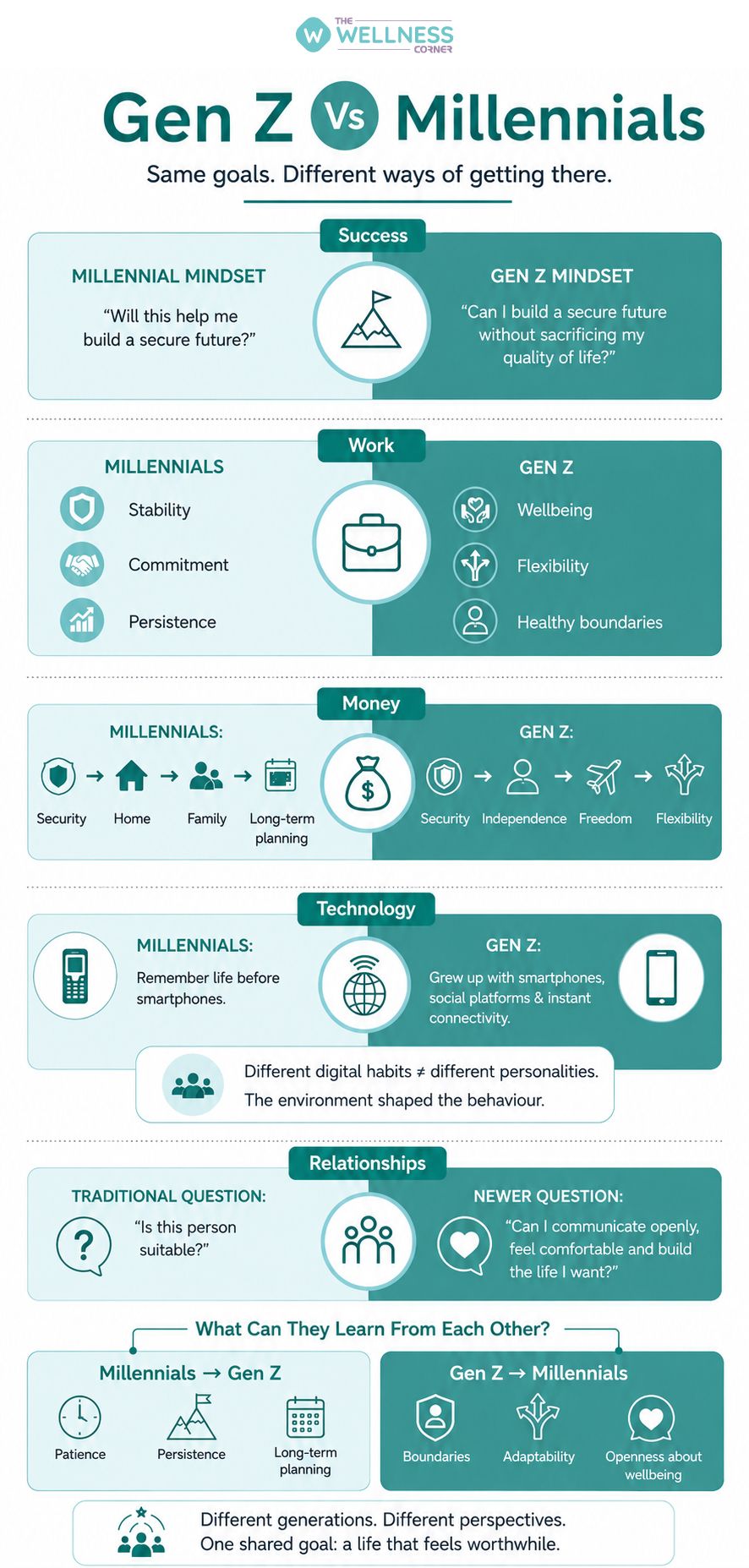
Same Goal, Different Definition Of Success
Both generations want a satisfying life. What differs is often the definition of what that life should look like.
For many millennials, success has traditionally been linked with building stability. A steady career, growing income, financial security and long-term planning may feel like important milestones.
Gen Z is often more likely to question whether achieving those milestones is worth sacrificing personal wellbeing.
The questions may sound different:
Millennial approach:
“Will this decision help me build a secure future?”
Gen Z approach:
“Can I achieve financial security without sacrificing my quality of life?”
Neither perspective is automatically better.
They reflect different experiences of adulthood.
Work Is More Than A Paycheck
Work remains important to both generations, but expectations around work have changed.
Many millennials entered professional life during a period when being highly available and working long hours were often viewed as signs of commitment. Staying with an organisation and gradually moving up the career ladder could be seen as the safest route to success.
Gen Z has entered workplaces where conversations about burnout, flexibility, workplace culture and boundaries are much more visible.
That can make younger employees more likely to ask:
“Why should working harder automatically mean living better?”
This does not mean Gen Z does not care about career growth. It may simply mean that career success is being measured alongside quality of life.
Also Read: Can AI Predict Mental Burnout Before It Happens?

Money Still Matters, But So Does Freedom
Both generations understand the importance of financial stability.
The difference may be in what financial stability represents.
For many millennials, earning more may be closely connected to achieving traditional milestones such as buying a home, supporting parents or starting a family.
For Gen Z, financial independence may also mean having the freedom to change careers, travel, pursue interests or avoid feeling trapped in a job they dislike.
This does not mean younger adults are less financially responsible. In many cases, concerns about rising expenses and uncertain career paths can make financial independence even more important.
The common ground is simple:
Both generations want greater control over their future.
They may simply imagine that control differently.
Technology Has Changed The Way We Live
This may be the most obvious difference.
Millennials remember a childhood before smartphones became part of everyday life. Many experienced the transition from desktop computers and early social media to today's highly connected digital world.
Gen Z has largely grown up with smartphones, social platforms, instant messaging and constant access to information.
That can influence communication and attention.
Gen Z may prefer faster conversations, visual content and immediate responses. Millennials may be more comfortable with longer emails, phone calls or communication styles that developed before constant connectivity became normal.
These are not personality flaws.
They are habits shaped by different environments.
Also Read: Meditations To Enhance Your Communication Skills

Why Gen Z May Question Traditional Expectations?
Gen Z has grown up watching major social changes happen in real time.
They have seen changing attitudes toward careers, relationships, mental health and identity. As a result, they may be less willing to accept traditions simply because they have always existed.
This can be especially noticeable in India.
Questions around marriage, career choices, living arrangements and gender roles may be approached differently than they were by previous generations.
A young adult may ask:
“Am I making this choice based on my own priorities or on what others expect from me?”
That question can sound rebellious to someone with a more traditional mindset, but psychologically it may simply reflect a stronger desire for autonomy.
Millennials Often Understand The Value Of Patience
If Gen Z is often associated with questioning the rules, millennials may represent the generation that learned to navigate them while gradually challenging them.
Millennials experienced many periods of uncertainty while entering adulthood, including changing job markets and rapid technological transformation.
As a result, some may place greater value on persistence.
They may be more comfortable staying with a difficult situation for longer because they have learned that progress is often gradual.
That mindset has an advantage.
Not every difficult situation needs to be abandoned immediately. Sometimes meaningful results require patience, consistency and the willingness to keep learning.
At the same time, staying too long in an unhealthy situation simply because “hard work pays off” can also become a problem.

Relationships Are Changing Too
Generational differences become even more noticeable when relationships enter the conversation.
Millennials may have grown up with stronger expectations around traditional relationship milestones such as dating, marriage and family life.
Gen Z has had greater exposure to different relationship models and more open conversations about emotional compatibility, communication and mental health.
This can create a major shift in priorities.
Instead of asking only:
“Is this person suitable?”
a younger adult may also ask:
“Can I be open and vulnerable with this person without feeling uneasy?”
“Can we communicate openly?”
“Does this relationship fit the life I want?”
The focus moves from simply meeting a social milestone to evaluating the quality of the relationship itself.
Also Read: Do Relationships Fall Apart If The Woman Is Earning More?
Mental Wellbeing Is No Longer An Afterthought
Perhaps one of the biggest common changes across both generations is the growing importance of mental wellbeing.
Work stress, loneliness, burnout and emotional exhaustion are increasingly discussed openly rather than treated as private weaknesses.
Gen Z is often credited with making these conversations more visible, but millennials have embraced them too.
The result is a broader definition of health.
Being successful is not only about earning a good salary.
Being productive is not only about staying busy.
Being independent is not only about handling everything alone.
There is greater recognition that emotional wellbeing matters too.

Are Gen Z Really Less Committed?
This is one of the most common stereotypes, especially in the workplace.
A younger employee changing jobs may be labelled disloyal. A millennial staying in one organisation may be seen as dependable.
But behaviour needs context.
Changing jobs can mean a lack of commitment, but it can also reflect a desire for career growth, better working conditions or a different professional direction.
Similarly, staying in the same organisation can reflect loyalty, but it can also simply mean someone values stability.
Psychology reminds us to look beyond the behaviour itself.
Ask why the person made the choice.
The Best Approach May Be A Combination
Perhaps the most useful lesson from the Gen Z versus millennial debate is that both generations have something valuable to offer.
From millennials, younger adults can learn about patience, long-term financial planning and the value of persistence.
From Gen Z, millennials can learn about setting healthier boundaries, questioning outdated expectations and treating mental wellbeing as part of success.
Imagine combining the two approaches.
Work hard, but do not glorify exhaustion.
Plan for the future, but do not postpone your entire life.
Stay committed, but recognise when change is necessary.
Value financial security, but do not measure your entire worth through income.
That balance may be more useful than declaring one generation better than the other.

Psychology Says Context Matters More Than Labels
Gen Z and millennials may share many priorities while approaching them differently.
Both want meaningful relationships.
Both want financial security.
Both want career growth.
Both want a life that feels worthwhile.
The real difference often lies in the path they believe will take them there.
And that is where psychology offers an important reminder:
Generations can influence behaviour, but they do not define an individual.
A person's personality, upbringing, financial situation, culture and experiences may explain far more about their behaviour than their birth year.
So instead of asking which generation has the better approach to life, perhaps a better question is:
What can each generation learn from the other?
Build A Healthier Approach To Life With The Wellness Corner
Life can bring pressure from careers, finances, relationships and changing social expectations. Understanding your own habits and emotional needs can help you make healthier decisions instead of simply following what others expect.
Explore The Wellness Cornerfor practical resources on mental wellbeing, lifestyle habits, workplace wellness and personal growth.
FAQs
Leave a Comment

Sign-Up Now & Unlock
₹100 Cashback
Recently Published
Related Articles


Health Checks @ Home
Service
Explore



Follow us on:


© 2026 Truworth Health Technologies Pvt. Ltd.